In the high-altitude heart of the Minahasa highlands, the Tomohon Extreme Market (Pasar Beriman) operates as a visceral confrontation with the biological reality of the food chain. This is not a market for the faint of heart; it is a place where the “Chemical Sublime” of volcanic soil meets a culinary heritage that predates modern global norms. To the Minahasan people, the market is a site of pride and cultural identity, while to the outsider, it represents a profound challenge to the limits of the gastronomic imagination.
The Landscape of the Unfiltered
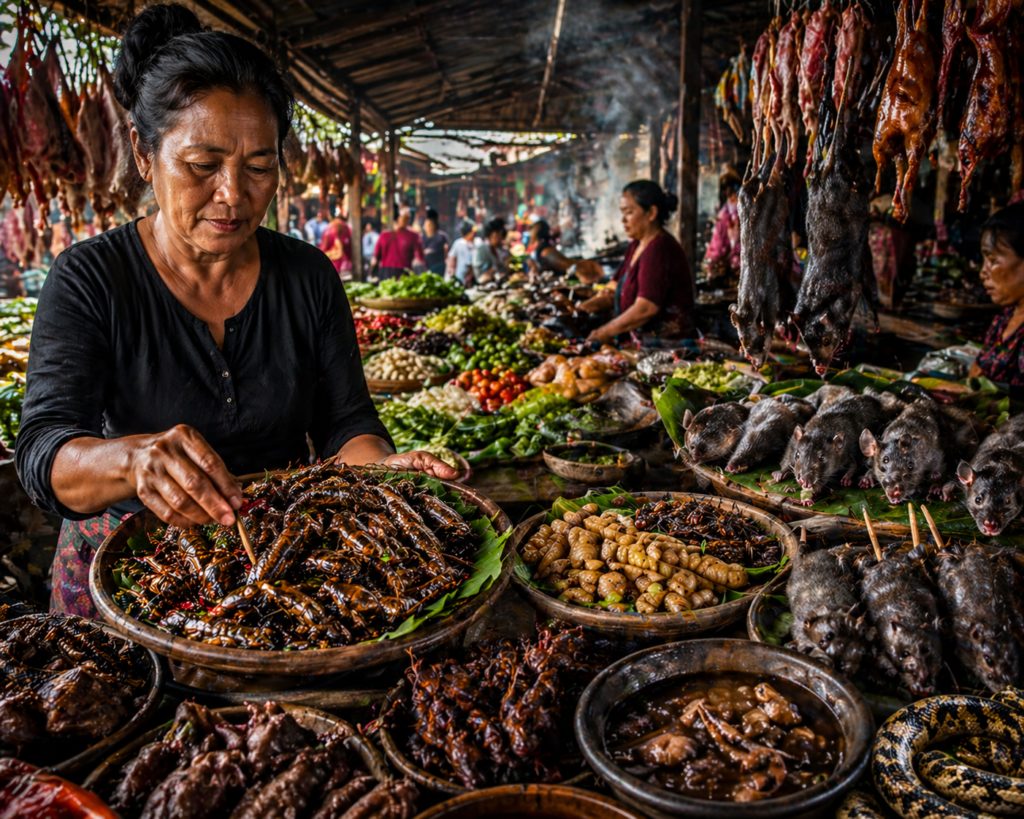
The aesthetic of Tomohon is one of raw, anatomical honesty. Unlike Western supermarkets where meat is sanitized, packaged, and divorced from its origin, Tomohon presents the animal in its entirety. Under the morning mist of the Lokon and Mahawu volcanoes, the stalls are lined with “extreme” proteins that have defined the Minahasan diet for centuries: forest rats, fruit bats (Paniki), pythons, and wild boar. The visual experience is a high-contrast tableau of scorched hides and deep crimson meats, set against the vibrant yellow of local spices and the emerald green of jungle ferns.
Paniki: The Geometry of the Night
One of the most iconic “adrenaline” dishes in Tomohon is Paniki, or fruit bat. Before it reaches the pot, the bat is scorched with a blowtorch to remove its fur, giving it a dark, leathery appearance that preserves the skeletal geometry of its wings. It is then slow-cooked in a heavy infusion of coconut milk, ginger, and an overwhelming amount of bird’s eye chili. The result is a meat that is lean and gamey, carrying the aromatic essence of the forest fruits the bats consume, masked by a heat that tests the physical endurance of the palate.
The Fire of the Minahasa
The “challenge” of Tomohon is not just the protein, but the Heat. The Minahasan culinary philosophy is built on the Rica-Rica—a spice paste dominated by ginger, lime leaves, lemongrass, and a staggering volume of chilies. This isn’t spice for the sake of pain; it is a functional preservative and a flavor enhancer designed to cut through the intense, musky flavors of wild game. Eating in Tomohon is a full-body experience—a chemical reaction where the endorphin rush of the chili balances the psychological weight of the exotic meat.
A Cultural Fortress
Beyond the shock factor, the Extreme Market is a testament to the Cultural Autonomy of the North Sulawesi people. In a world of increasing food homogenization, Tomohon remains a fortress of indigenous tradition. The consumption of these animals is rooted in ancient hunting practices and a “nose-to-tail” philosophy that wastes nothing. For the locals, the market is a social hub, a place where the “Legendary Street Foods” of the highlands are traded with a sense of normalcy that challenges global definitions of what is “edible.”
The Adrenaline of the Authentic
To visit Tomohon is to step outside the “safe” boundaries of global tourism and into a space of absolute, unapologetic authenticity. It is a confrontation with the primordial—a place where the smell of woodsmoke, the heat of the chili, and the sight of the unusual converge into a singular, unforgettable experience. It remains one of the few places on Earth where the act of eating is still a direct, raw engagement with the wild, volcanic landscape of the Indonesian archipelago.