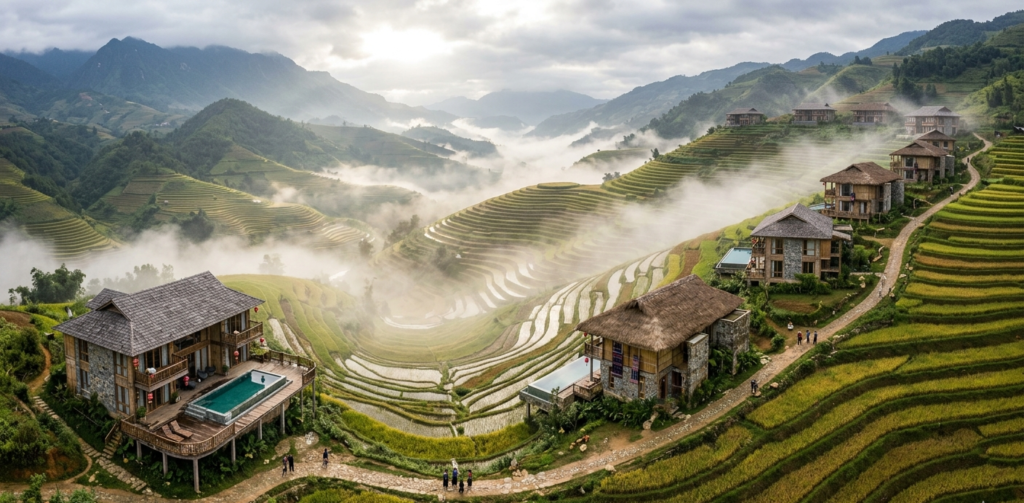
In the high-altitude reaches of Sapa, the landscape is a living sculpture. For centuries, the Hmong, Dao, and Tay ethnic groups have hand-carved the mountainsides into intricate rice terraces that shimmer like emerald glass under the mountain sun. The “Ethnic Luxury” movement in Vietnam focuses on the Sustainable Vernacular—building lodges that honor the stilt-house traditions and textile arts of the mountain tribes while providing a sanctuary of modern warmth. These ten lodges offer a seat above the clouds, where the morning mist rolls over the terraces like a silent tide.
1. Topas Ecolodge: The Circular Stone Sanctuary
Perched on a dramatic hilltop, Topas is world-renowned for its Minimalist Stone Bungalows. The architecture uses local granite to create sturdy, circular structures that withstand the mountain winds. The infinity pool here is legendary, appearing to pour directly into the Muong Hoa Valley. It is a masterclass in “High-Altitude Engineering” and sustainable tourism.
2. Hotel de la Coupole – MGallery: The Indochine Fantasy
Designed by Bill Bensley, this hotel is a vibrant fusion of French Haute Couture and Hill Tribe Culture. The architecture is grand and eccentric, using the bright yellows of French colonial villas and the intricate patterns of Sapa’s ethnic textiles. For a designer, the “clash” of colors and textures here is a brilliant study in maximalist luxury.
3. Sapa Jade Hill Resort: The European-Hmong Village
Designed like a sprawling mountain village, Jade Hill features stone-and-wood villas tucked among pine trees. The architecture focuses on Warmth and Hearth, with rustic chimneys and large fireplaces. The botanical setting is immense, with the villas surrounded by plum and peach blossoms that bloom in the spring.
4. Silk Path Grand Resort & Spa: The Imperial Citadel
Located on a high hill overlooking the Hoang Lien mountain range, this resort feels like a grand Indochinese Manor. The architecture uses classical arches and grand balconies, surrounded by over 100 species of roses and local flora. It represents “Stately Luxury,” offering a wide-angle view of the legendary Fansipan peak.
5. Ville De Mont Mountain Resort: The Cliffside Masterpiece
Situated 1,550 meters above sea level, this resort is built directly into the side of a steep cliff. The design utilizes Local Stone and Reclaimed Wood, featuring floor-to-ceiling windows that make the clouds feel like they are entering your room. It is a stunning example of “Gravity-Defying Design.”
6. Pao’s Sapa Leisure Hotel: The Terraced Monolith
The building itself is an architectural tribute to the landscape; its curved, stepped balconies are designed to mimic the Flow of the Rice Terraces. For an engineering student, the way the building follows the natural contour of the hillside is a perfect example of organic urban integration.
7. Laxsik Ecolodge: The Hmong Stilt-House Reimagined
Laxsik focuses on the Vernacular Architecture of the Hmong people. The lodges are built on stilts, using traditional bamboo-weaving techniques and wood joinery. The luxury here is the “Tactile Experience”—the feel of the hand-woven fabrics and the scent of the natural timber.
8. Eco Palms House: The Retreat of Five Tribes
This lodge features bungalows designed to represent the five different ethnic groups of Sapa. Each unit uses different Building Materials and Patterns (from Black Hmong wood to Red Dao mud-wall styles). It is a “Living Museum” of mountain architecture, offering total immersion into the local culture.
9. Victoria Sapa Resort & Spa: The Alpine Nostalgia
Built like a traditional mountain chalet, the Victoria is the pioneer of luxury in Sapa. Its design uses heavy timber beams and stone hearths, reminiscent of French Alpine Lodges but with a distinct Vietnamese soul. It feels like a cozy, historic outpost in the middle of the rugged frontier.
10. Lee’s House: The Boutique Rustic Chic
A smaller, more intimate “Art-Lodge” that focuses on Creative Repurposing. The design is bohemian and raw, featuring recycled wood and open-air spaces that face the Muong Hoa stream. It is a favorite for photographers and designers looking for a “Low-Fi, High-Aesthetic” mountain experience.