
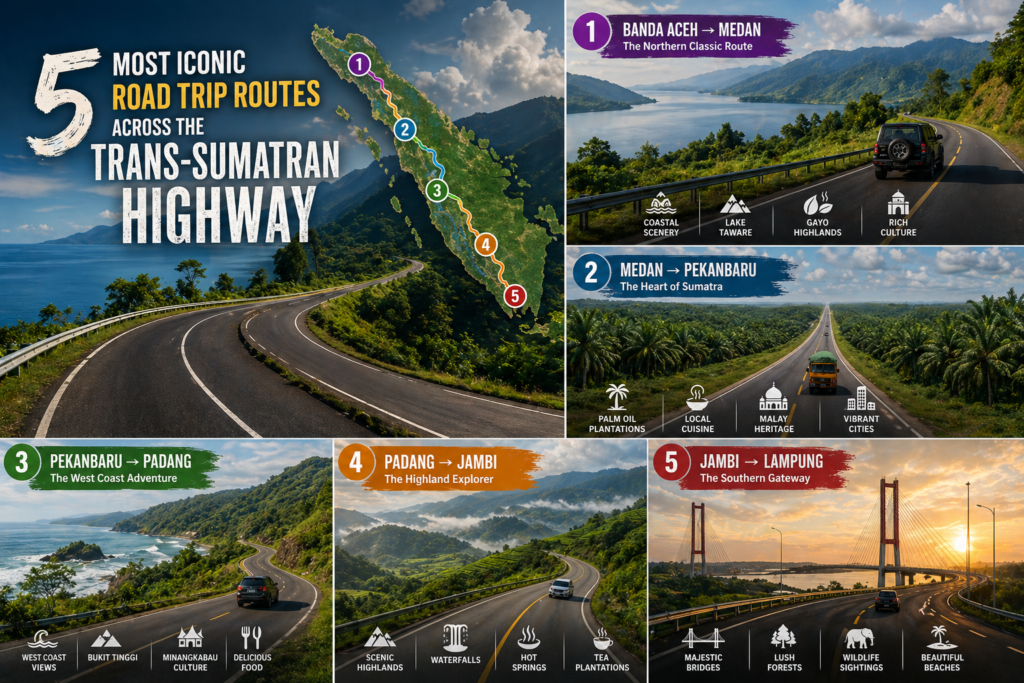
1. The Kelok 9 & Harau Highlands (West Sumatra)
This is arguably the most visually stunning engineering feat on the entire highway. Located near Payakumbuh, the Kelok 9 is a massive multi-level bridge system that snakes through a narrow mountain pass, connecting West Sumatra to Riau. The road is flanked by the towering vertical cliffs of the Harau Valley, often shrouded in mountain mist. This segment transitions from the architectural precision of the flyovers into the ancient, emerald-green landscapes of the Minangkabau highlands, offering a perfect blend of modern infrastructure and primordial nature.
2. The Parapat Ascent to Lake Toba (North Sumatra)
The drive toward the world’s largest volcanic lake is a ritual of elevation. Starting from the lowlands, the road twists upward through the humid rubber and palm oil plantations of North Sumatra until the air suddenly cools. The iconic moment occurs at the “rim” of the caldera, where the forest opens up to reveal the massive, deep-blue expanse of Lake Toba and Samosir Island below. The descent into the lakeside town of Parapat is a series of hairpin turns that provide constant, panoramic views of the water, making it one of the most photographed stretches of the highway.
3. The Seulawah Pass: The Gateway to the North (Aceh)
At the northernmost end of the highway lies the Seulawah Pass, a mountainous transit point that cuts through the Seulawah Agam and Seulawah Inong volcanoes. This route is famous for its dense tropical canopy and the “monkey forest” sections where macaques line the roadside. The road is narrow and steep, demanding total concentration, but the reward is the dramatic entrance into the Aceh valley. The air here is heavy with the scent of wild forest and the wood-fired coffee from the roadside stalls (Warung Kopi) that serve as the social heartbeat of this northern route.
4. The Bukit Barisan Spine (Bengkulu to South Sumatra)
This segment follows the Bukit Barisan, the volcanic mountain range that forms the literal backbone of Sumatra. This is the “wild” section of the highway, where the road hugs the edges of the Kerinci Seblat National Park. The scenery is a relentless wall of deep-green rainforest, occasionally broken by views of steaming volcanic peaks and terraced tea plantations. It is a lonely, atmospheric drive that emphasizes the sheer scale of the Sumatran wilderness, where the “Screws, Steam, and Shadows” of old colonial outposts occasionally appear in the mist.
5. The Musi River Crossing & The Palembang Delta (South Sumatra)
As the highway moves into the southern lowlands, the mountain curves give way to massive, sweeping bridges over the island’s great rivers. The entry into Palembang is the urban climax of the southern route. Crossing the Musi River—the “Amazon of Sumatra”—provides a view of a sprawling water-based civilization. The highway here is defined by wide lanes and the industrial energy of the south, where the road begins its final descent toward the Sunda Strait, signaling the transition from the rugged Sumatran interior to the gateway of Java.