1. Rambu Solo: The Grand Send-Off
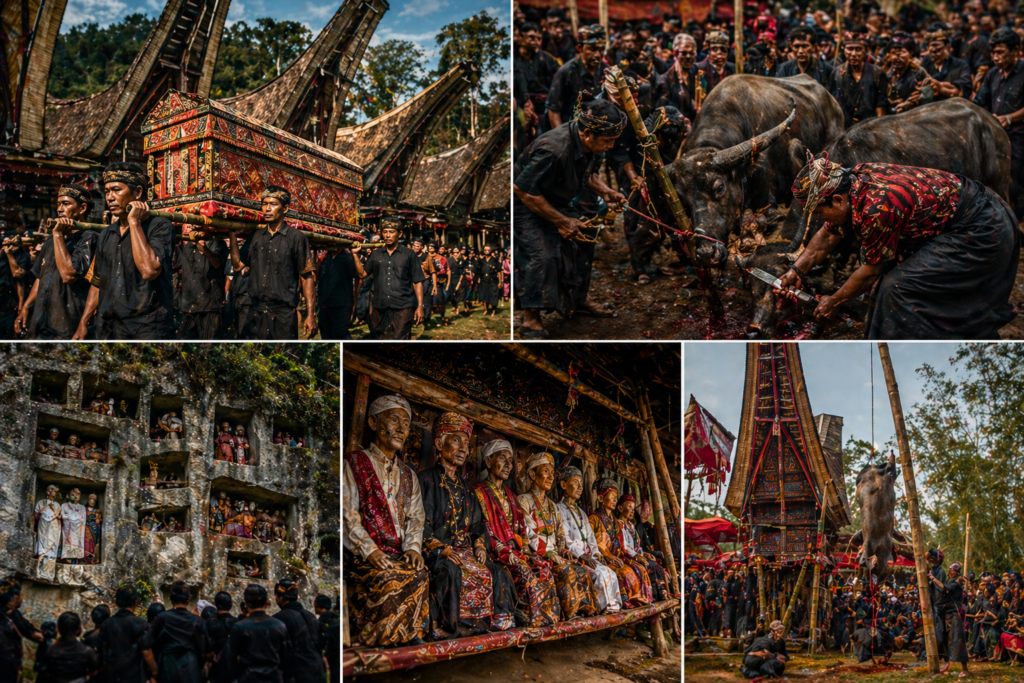
The Rambu Solo is arguably the most complex funeral ceremony in the world. It is not held immediately after death; it can take months or even years of preparation. During this time, the deceased is not considered “dead” but Tula’ Makula’ (a sick person) and remains in the family home. The ritual involves days of traditional dance, music, and the sacrifice of water buffalo (Ma’pasilaga Tedong). The belief is that the spirit of the buffalo carries the soul to the afterlife—the more buffalo sacrificed, the swifter the soul’s journey to the heavens.
2. Ma’nene: The Second Funeral
Perhaps the most visually striking ritual, Ma’nene (The Cleaning of the Corpses) occurs every few years in August. Families return to the ancestral stone graves to exhume their loved ones. The bodies, preserved by traditional mummification and the cool mountain air, are cleaned, groomed, and dressed in fresh, new clothes. This is not a macabre act, but a deeply tender celebration of love. It is a time for the living to “introduce” new family members to their ancestors and to maintain a physical bond that death cannot break.
3. Passiliran: The Baby Trees
One of the most poignant manifestations of Torajan belief is the Passiliran ritual. When an infant who has not yet grown teeth passes away, they are buried inside the hollowed-out trunk of a living “Tarra” tree. The tree is chosen for its abundant white sap, which symbolizes mother’s milk. The belief is that as the tree grows, it absorbs the child’s body, and the child’s soul continues to live and grow through the tree, eventually reaching the sky as the branches climb higher.
4. Ma’palao: The Procession to the Tongkonan
Before the final burial, the casket—shaped like a traditional Tongkonan house or a boat—must be moved from the family home to the ceremonial site. This is the Ma’palao. It is a high-energy, rhythmic procession where hundreds of people carry the ornate casket on a bamboo structure. Along the way, the carriers often engage in a playful “tug-of-war” or shaking of the casket. This is intended to show the deceased that their family is strong and united, ensuring they can leave this world without worrying about the stability of the kin they leave behind.
5. Tau-Tau: The Silent Watchers
While not a ritual in the kinetic sense, the creation and installation of the Tau-Tau is a vital funerary rite. These are life-sized wooden effigies carved in the likeness of the deceased. Once the body is interred in a “hanging grave” or a stone chamber carved into a cliffside, the Tau-Tau is placed on a balcony overlooking the valley. These effigies serve as the “eyes” of the ancestors, watching over the living and the village. The ritual of carving and “inviting” the spirit into the wood ensures that the wisdom of the deceased remains an active part of the community’s daily landscape.