In the landscape of the Indonesian archipelago, few sights command as much spiritual and physical awe as Mount Rinjani. Rising 3,726 meters above sea level in the Mount Rinjani National Park (Taman Nasional Gunung Rinjani) of North Lombok, this massive stratovolcano is more than just a mountain; it is a “Volcanic Cathedral.” For the local Sasak people, it is the seat of the gods, a vertical sanctuary where the earth meets the heavens.
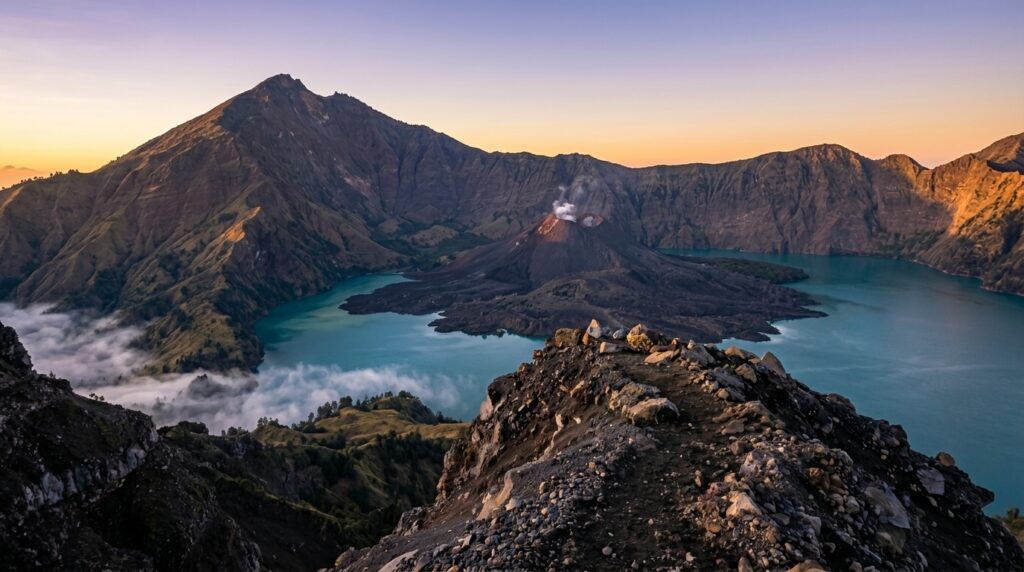
The journey begins in the high-altitude valleys of Sembalun Lawang in East Lombok, an ancient caldera floor sitting at 1,150 meters. From this eastern gateway, the ascent is a masterclass in ecological transition. The trail quickly transforms from rolling savannas into a grueling vertical incline defined by steep, serrated ridges. The climax of this physical commitment is reaching the Sembalun Crater Rim, a narrow knife-edge of volcanic scree where the world suddenly drops away, revealing a dizzying plunge into the heart of the mountain.
Nestled 600 meters below this rim at an altitude of 2,000 meters lies Segara Anak (Child of the Sea). This crescent-shaped crater lake is a geological miracle—a body of turquoise water held in the palm of a volcano. At its edge sits Gunung Baru Jari, a “baby” volcano that periodically vents plumes of steam. The lake acts as a spiritual reservoir, reflecting the jagged walls of the caldera like a dark, liquid mirror. Nearby, natural hot springs offer a sensory sanctuary, with scalding water flowing over sulfuric yellow rocks just a short walk from the lakeshore.
The ultimate reward for the midnight summit push to the 3,726-meter peak is the “Celestial Shadow.” As the sun rises, it casts a perfect, triangular shadow of Rinjani that stretches for miles across the Lombok Strait toward Bali. From this height, you can see the entire span of the island, from the northern coast of Bayan to the distant peaks of Sumbawa in the east.
To exit this cathedral, many trekkers descend through the lush rainforests of Senaru Village in North Lombok. Located at 600 meters elevation, Senaru provides a stark, green contrast to the volcanic summit and serves as the source of the Sendang Gile and Tiu Kelep waterfalls, which are fed by the lake’s overflow. To trek Rinjani is to navigate this complete circuit of Lombok’s geography—from the strawberry fields of Sembalun to the frozen summit, and finally back down into the tropical canopy of the north.