
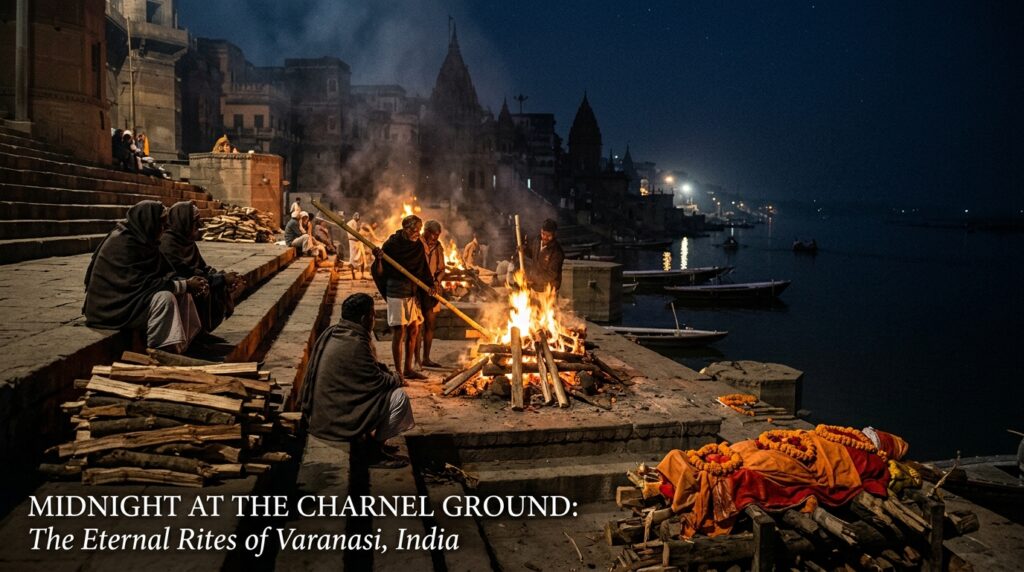
Varanasi, also known as Kashi, is one of the oldest continuously inhabited cities on Earth. It is a place where the barrier between the living world and the afterlife is considered thinnest. Along the banks of the sacred Ganges River, the city’s life centers on the Ghats—massive stone stairways that lead down to the water. While the city is a center of culture and devotion, it is also the ultimate destination for death, where the funeral pyres of the Manikarnika and Harishchandra Ghats burn twenty-four hours a day, year after year.
1. The Eternal Flame of Manikarnika At the heart of Varanasi’s spiritual identity is the belief that dying here grants Moksha, or liberation from the cycle of rebirth. At Manikarnika Ghat, the “Great Cremation Ground,” the fire is said to have burned continuously for centuries. It is a raw, intense landscape of charred wood, rising smoke, and the constant chanting of prayers. Unlike many cultures that shield themselves from the reality of death, Varanasi embraces it as a public, sacred transition.
2. The Aghori: Ascetics of the Fringe Among the smoke of the funeral pyres, one may find the Aghori—a sect of Shaivite ascetics known for their extreme and often misunderstood practices. To an Aghori, there is no distinction between the pure and the impure, the beautiful and the terrifying. They often coat their bodies in human ash from the pyres, a symbolic reminder of the impermanence of the physical body. Their presence at the charnel grounds at midnight is a spiritual exercise in conquering fear and transcending the ego.
3. The Nocturnal Symphony of the Ganges As the city sleeps, the atmosphere at the riverbank shifts from the chaotic energy of the day to a heavy, ritualistic silence. The sound of the flowing river mingles with the crackle of burning sandalwood and the distant tolling of temple bells. In the darkness, the only light comes from the glowing embers of the pyres and the flickering diyas (oil lamps) set adrift on the water. It is a scene of profound sensory intensity, where the smell of incense and woodsmoke fills the humid night air.
4. The Architecture of the Afterlife The landscape of the Ghats is a labyrinth of ancient stone temples, narrow alleys, and crumbling palaces that lean precariously over the river. This vertical architecture creates a sense of being trapped in time. At night, the shadows cast by the temple spires against the smoke-filled sky create a silhouette that has remained largely unchanged for a millennium. It is an urban space where every stone has been smoothed by the feet of millions of pilgrims over centuries.
5. A Lesson in Impermanence Varanasi does not offer a comfortable experience; it offers an authentic one. Watching the rituals on the banks of the Ganges at midnight forces a confrontation with the fundamental truth of human existence: that everything is transitory. The rituals of the Aghori and the perpetual fires of the Ghats serve as a visceral reminder that, in the end, all material things return to the basic elements of fire, water, and ash. It is a place of absolute finality, and yet, paradoxically, it is where many find their deepest sense of peace.