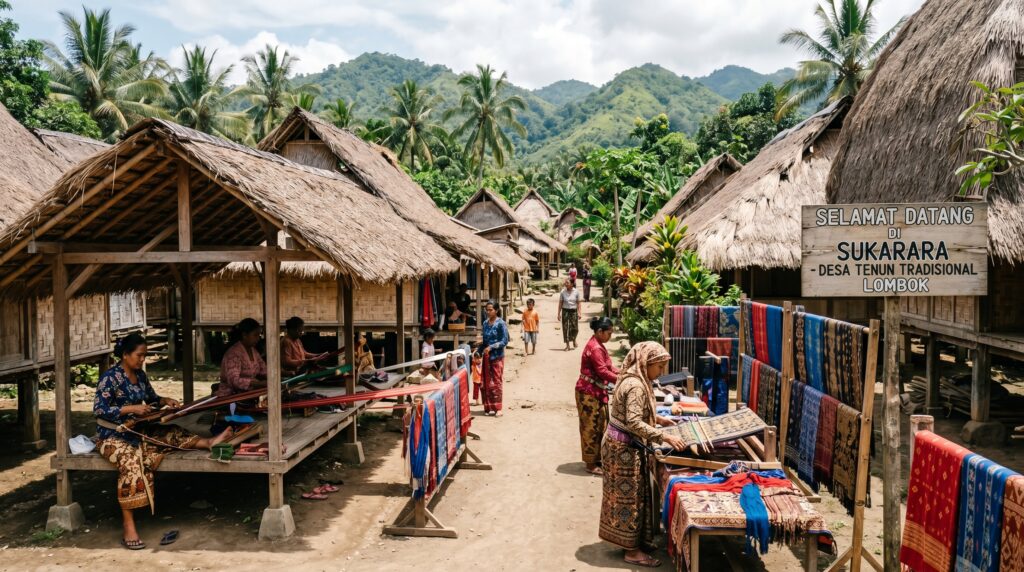
Sukarara is more than just a destination; it is a living museum of Sasak textile artistry. Located just a short drive from the Lombok International Airport, this village is the primary guardian of the Tenun Ikat and Songket traditions. Here, the “Stay” is an educational one, where you witness a craft that has been passed down from mother to daughter for centuries. The architecture of the village—filled with traditional looms and colorful yarns drying in the sun—provides a high-fidelity look into a culture that refuses to let its heritage be erased by modernity.
I. The Living Heritage of Songket Production
In Sukarara, weaving is a rite of passage. It is traditionally said that a Sasak woman cannot marry until she has mastered the art of the loom. As you walk through the village, the rhythmic “clack-clack” of the wooden looms serves as the heartbeat of the community. The Songket produced here is world-renowned for its intricacy, often incorporating gold and silver threads into complex geometric patterns. Observing the weavers is a study in “Human Engineering”—the precision and patience required to track hundreds of threads simultaneously is a staggering feat of mental and physical focus.
II. Technical Mastery: The Weaving Process
A visit to Sukarara offers a deep dive into the technicalities of textile creation. You can observe the entire lifecycle of a garment, from the hand-spinning of raw cotton to the application of natural dyes derived from bark, leaves, and mud. The process of Ikat (meaning “to tie”) involves tying off sections of the yarn before dyeing to create intricate, blurred patterns. This “Discovery” phase of your visit allows you to appreciate the value of a single piece of cloth, which can take anywhere from two weeks to several months to complete, depending on the complexity of the motif.
III. Symbolism and Motifs: The Language of Threads
Every pattern woven in Sukarara tells a story. The most famous motif is the Subahnale, a complex design that is so difficult to weave that the weavers would often exclaim “Subhanallah” (Praise be to God) upon its completion. Other motifs represent the local flora, fauna, and the philosophy of the Sasak people, such as the Lumbung (rice barn) symbol representing prosperity. Understanding this “Visual Language” transforms a simple souvenir into a piece of history, connecting you directly to the spiritual and social values of the Lombok highlands.
IV. Interactive Cultural Immersion
Sukarara is unique because it encourages visitors to step behind the loom. You can participate in a short introductory lesson, feeling the tension of the threads and the weight of the shuttle as you try to master a single row of weaving. This “Hands-On Escape” provides a profound respect for the artisans’ skill. Additionally, the village allows guests to dress in traditional Sasak wedding attire for photographs against the backdrop of their ancient Bale Tani houses, offering a high-fidelity cultural experience that is both respectful and memorable.
V. Supporting the Local Cooperative Ecosystem
The village operates under a cooperative system that ensures the sustainability of the craft and the fair treatment of the weavers. When you purchase a textile in Sukarara, you are directly supporting the local economy and the preservation of this ancient art form. The logistics of visiting are simple—it is a mandatory stop for anyone interested in “Heritage Travel.” By engaging with the weavers and learning their stories, you help ensure that the threads of Sasak culture remain vibrant and strong for generations to come.