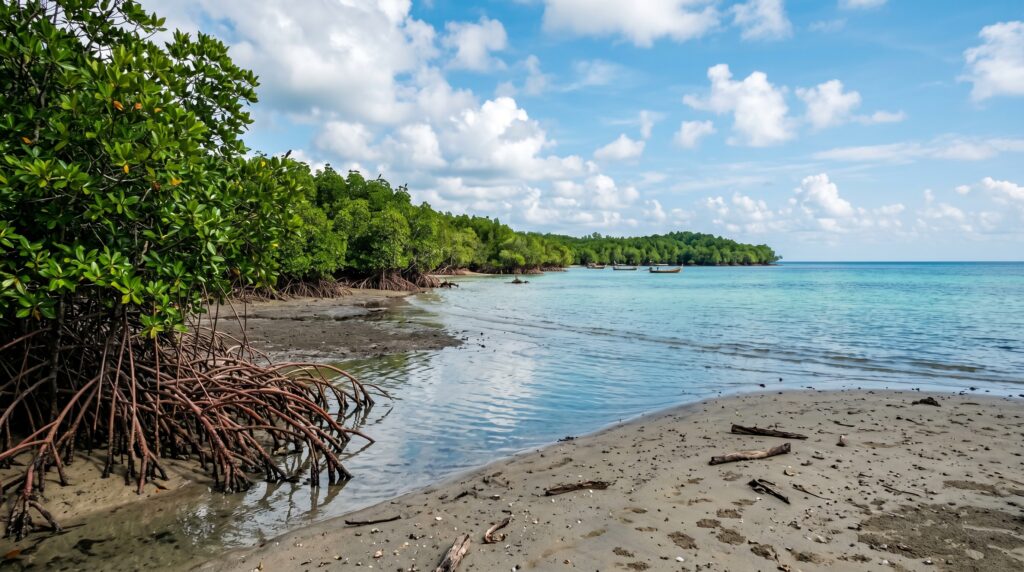
While the south of Lombok is famous for its white-sand surfing bays, the northeastern coast offers a completely different “Escape”—a prehistoric water wilderness known as Gili Petagan. This uninhabited island is part of a small cluster in the Sambelia district, dominated by ancient, towering mangrove forests that have stood for centuries. Visiting Gili Petagan is a lesson in “Nature’s Engineering,” where the complex root systems of the mangroves create a high-fidelity labyrinth of emerald canals. It is an essential destination for those seeking a quiet, “Off-the-Grid” adventure far from the mainland crowds.
I. Access Point: The Transit from Kondo Harbor
The journey begins at Kondo Harbor (Pelabuhan Kondo) in Sambelia, East Lombok. This small, local port is the primary gateway for chartering a traditional wooden outrigger boat (perahu). The transit to Gili Petagan takes approximately 20 to 30 minutes. Logistically, it is best to arrive at the harbor before 9:00 AM to ensure calm waters and to beat the midday heat. The boat ride itself is part of the “Discovery,” offering a panoramic view of the massive Mount Rinjani as it looms over the coastline, providing a stark contrast to the low-lying mangrove islands ahead.
II. Navigating the “Secret” Seawater Canals
The defining feature of Gili Petagan is the series of narrow, natural canals that snake through the heart of the mangrove forest. Navigating these channels requires a skilled local captain who understands the tide. At high tide, your boat can glide deep into the forest, where the canopy of leaves creates a natural tunnel, blocking out the sun and dropping the temperature significantly. The water here is crystal clear, allowing you to see the intricate “breathing roots” of the mangroves and the diverse marine life that uses this forest as a nursery. It is a high-fidelity sensory experience of silence, broken only by the sound of your boat’s hull cutting through the water.
III. The Underwater Gardens and “Blue Lagoon”
Just off the edge of the mangrove forest lies a hidden “Blue Lagoon” and a vibrant coral reef system. The logistics of the trip usually include a stop here for snorkeling. Unlike the more popular Gili islands in the north, the reefs at Gili Petagan are exceptionally well-preserved due to low foot traffic. You can expect to see massive table corals and schools of tropical fish in water that feels like a private swimming pool. This “Marine Sanctuary” provides a peaceful alternative to the busy tourist hubs, offering a raw and unfiltered connection with Lombok’s underwater biodiversity.
IV. Understanding the Mangrove Ecosystem Conservation
Gili Petagan is a critical conservation area. The mangroves act as a natural barrier against coastal erosion and serve as a massive carbon sink. Visitors are encouraged to practice “Low-Impact Tourism”—this means taking all trash back to the mainland and avoiding physical contact with the sensitive root systems. Many local guides are now being trained in conservation, and engaging with them offers a “Deep Dive” into the ecological importance of this forest. Learning how these trees filter salt and provide a habitat for migratory birds adds an intellectual layer to your physical “Adventure.”
V. Essential Gear and Timing for the “Silent Escape”
To make the most of Gili Petagan, timing is everything. The best months to visit are during the dry season (May to October) when the skies are clear. Essential gear includes waterproof bags for your camera, eco-friendly sunscreen, and plenty of water, as there are zero commercial facilities on the island. This lack of infrastructure is exactly what makes the “Stay” (even if just for a few hours) so rewarding. It is a place that demands you disconnect from your devices and reconnect with the primal, rhythmic pulse of the ocean and the forest.