
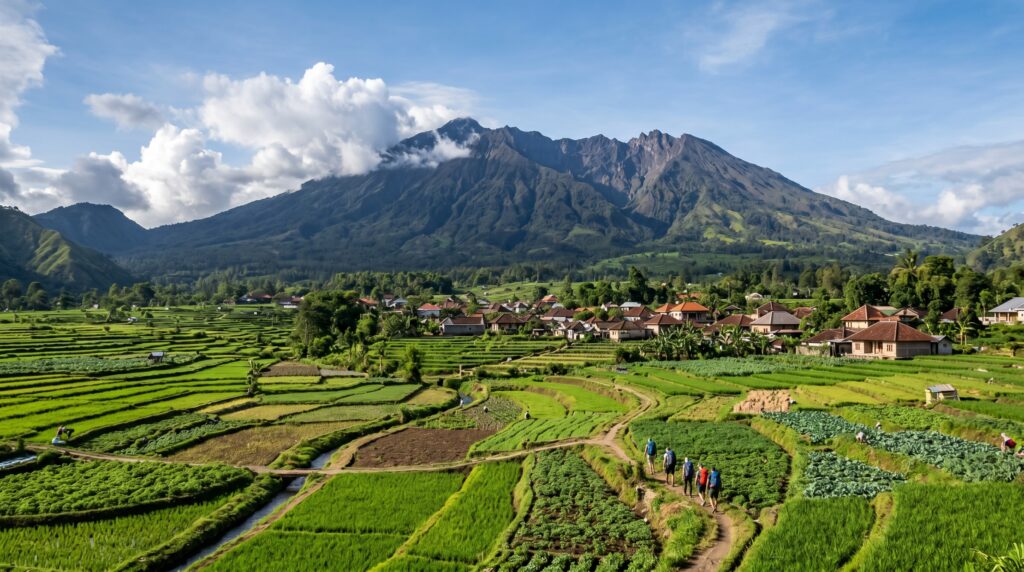
While the summit of Mount Rinjani is the ultimate goal for many, Bukit Selong (also known as Selong Hill) offers a high-fidelity “Aerial View” of Lombok’s agricultural heart without the multi-day commitment. Located in the high-altitude village of Sembalun, this viewpoint sits at approximately 1,100 meters above sea level. It is a place where the air is thin and crisp, and the landscape resembles a vibrant, giant patchwork quilt. For photographers and hikers, it provides an “Escape” into a world of geometric precision and natural grandeur.
I. The Vantage Point: Coordinates of the “Patchwork” View
The primary draw of Bukit Selong is the breathtaking view of the Sembalun valley’s agricultural plots. From the wooden viewing platforms, you look down upon hundreds of perfectly square fields of garlic, onions, strawberries, and rice. The technical beauty lies in the “Ancient Caldera” geography—the village is built inside the remains of a massive prehistoric volcano, with steep, jagged walls surrounding the flat, fertile floor. This creates a natural amphitheater that looks particularly stunning during the “Golden Hour,” when the low sun defines the edges of every field with long, dramatic shadows.
II. Access and Trail Logistics
Reaching the viewpoint is relatively straightforward but requires a short, invigorating climb. The trailhead is located in Desa Beleq, a historical sub-village of Sembalun. After paying a small entrance fee at the local post, you follow a well-maintained path and a series of stairs. The hike takes about 10 to 15 minutes, making it accessible for those who want an “Adventure” without the physical toll of a major trek. Along the way, you pass ancient Sasak houses that provide a glimpse into the architectural heritage of the mountain people before reaching the ridge that overlooks the valley.
III. The Historical Context of Desa Beleq
At the base of Bukit Selong lies Desa Beleq, the original ancestral village of the Sembalun people. This site consists of seven traditional houses (Bale) that have been preserved to honor the founding families of the area. Visiting this site before or after your hike adds a layer of “Heritage Discovery” to your trip. The architecture, featuring bamboo walls and thatched roofs, is designed to withstand the cold mountain temperatures. Understanding the history of these “Seven Houses” provides a cultural anchor to the vast landscape you see from the hilltop.
IV. Photography and the “Sea of Clouds”
For those seeking high-fidelity imagery, timing is critical. Arriving at Bukit Selong at dawn (around 5:30 AM) often rewards hikers with a “Sea of Clouds” phenomenon. As the valley floor is still cool, mist settles between the fields, while the sun rises behind the distant hills of East Lombok. The contrast between the mist-covered greenery and the rising sun creates a cinematic atmosphere. It is the perfect spot for “Landscape Reflection,” where the sheer scale of the Rinjani foothills makes the modern world feel miles away.
V. Climate and Essential Preparation
Because of its elevation, Sembalun is significantly cooler than the coastal areas of Lombok. Temperatures can drop to 15°C at night and early morning. Visitors should pack a light jacket and wear shoes with good grip for the gravelly sections of the trail. There are small local stalls at the base of the hill selling fresh Sembalun coffee and local snacks, allowing for a “Slow Living” moment after your descent. It is a destination that proves you don’t always have to climb the highest peak to find the most profound “Perspective.”