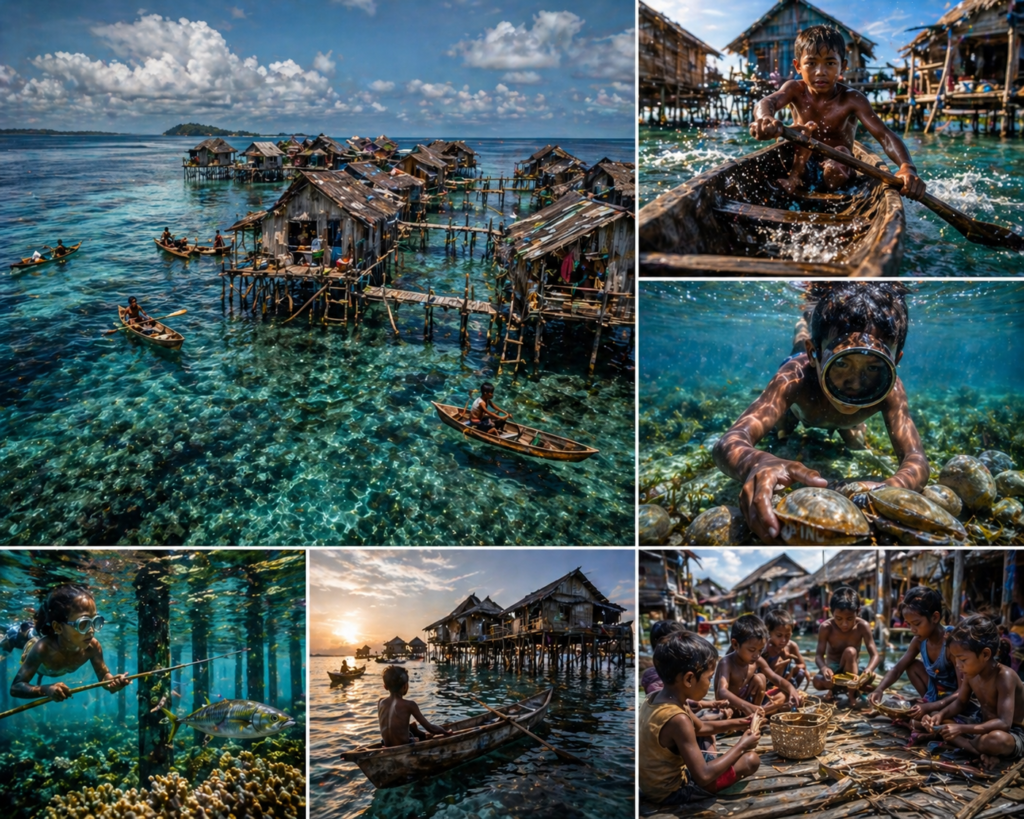
In the remote corners of the Sulawesi Sea, the map blurs where the land should begin. Here, the Bajo—the legendary Sea Nomads of Wakatobi—have engineered a life that defies the terrestrial bias of human history. They do not merely live near the ocean; they live on it, having constructed an entire civilization of stilted timber and coral stone that floats above the undulating tides of the Coral Triangle.
The Architecture of the Tide A Bajo village is a marvel of aquatic urbanism. Houses are perched on slender, resilient stilts made of ironwood, driven deep into the reef flats. There are no streets, only a labyrinth of narrow wooden boardwalks and “liquid alleys” where the primary mode of transport is the lepa-lepa (traditional dugout canoe). The architecture is intentionally porous; the gaps between the floorboards allow the sea breeze to cool the interior, while the rhythm of the waves beneath the floor serves as a constant, rhythmic heartbeat for the home.
The Geometry of the Reef The Bajo have a unique relationship with the geology of the sea. To create stable foundations for their community buildings and mosques, they harvest dead coral heads to build artificial islands known as “coral embankments.” This is a slow, generational form of land reclamation—building a solid world out of the debris of the reef. The result is a hybrid landscape where the boundary between “natural” and “man-made” disappears, creating a village that looks like a biological extension of the reef itself.
Physiological Evolution: The Human Amphibian Living above the waves for centuries has done more than shape Bajo culture; it has shaped their biology. Studies have shown that the Bajo have developed enlarged spleens, a genetic adaptation that allows them to stay underwater for extraordinary lengths of time by regulating oxygen more efficiently. They are the world’s premier free-divers, capable of walking on the seafloor at depths of 20 meters to hunt for fish with hand-crafted spearguns. To a Bajo, the “surface” is merely a place to sleep; the “depths” are where life happens.
A Liquid Cosmology For the Sea-Dwellers, the ocean is a sentient entity. Their belief system is a deep-rooted animism where every current, reef, and whirlpool is inhabited by spirits. They do not “own” the water; they negotiate with it. This spiritual contract ensures a profound level of marine stewardship. They take only what they need, moving their nomadic fleets when the fish stocks dwindle, allowing the reef time to breathe and regenerate. Their “civilization” is one of mobility and transience, proving that stability doesn’t require a foundation of soil.
The Horizon as a Home To stand in a Wakatobi water village at sunset is to witness a world without fences. The horizon is wide, and the sky is reflected perfectly in the shallow turquoise flats. The Bajo civilization is a reminder of human resilience and the ability to adapt to the most fluid environments on Earth. It is a society built not on the accumulation of land, but on the mastery of the currents—a floating testament to a life lived in total, unapologetic harmony with the sea.