- Location: Sukarara Village, Jonggat, Central Lombok
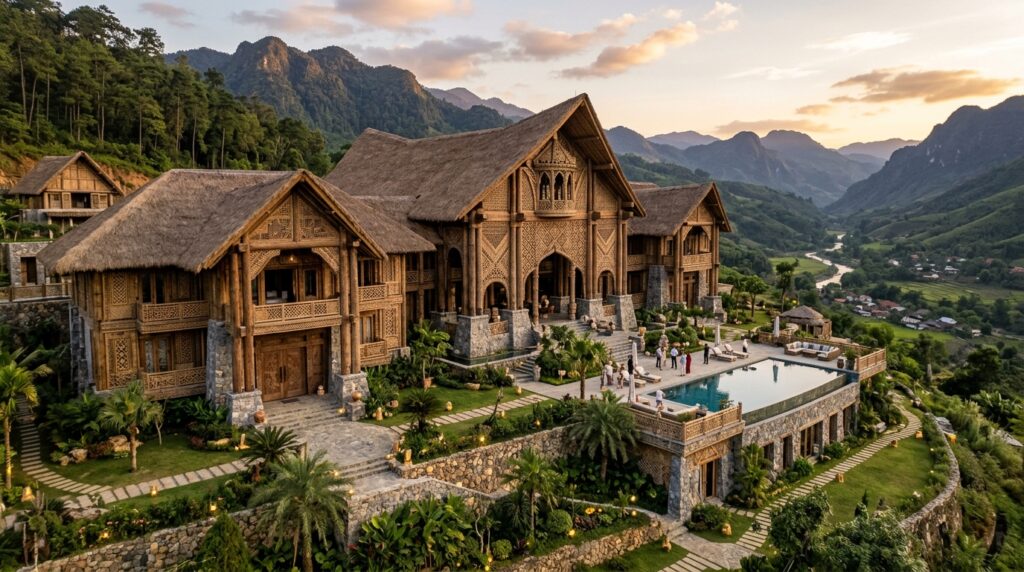
Stepping into the earthen courtyards of Sukarara Village trades the coastal breeze of Lombok for the rhythmic, wooden clacking of ancient back-strap looms (bback). In this historical heartland of Sasak textile arts, weaving is not merely a craft but a vital cultural language passed down through generations of women. These five immersive workshops invite you to sit on the smooth timber terraces of traditional thatched houses, working side-by-side with master weavers to harvest natural plant dyes, spin raw cotton threads, and learn the complex mathematical geometry behind the island’s legendary Songket fabrics.
1. The Indigo Leaf Foraging and Vat Preparation
The journey into Sasak textile heritage begins before a single thread is ever placed on the loom. Walking into the fertile agricultural fields bordering Sukarara Village, a master dyer guides you in harvesting the fresh green leaves of the Tarum (indigo) plant and wild Katu shrubs. Returning to the workshop courtyard, you will crush the leaves by hand in massive stone mortars, mixing the pulp with lime and wood ash in large clay vats to kickstart the natural fermentation process. Watching the dark, murky liquid slowly oxidize under the midday sun to reveal a deep, brilliant royal blue hue offers a fascinating, tactile lesson in organic chemistry and ancient color alchemy.
2. The Raw Cotton Spinning Circle
Set under the shade of a high-pitched Berugaq (a traditional wooden pavilion), this foundational workshop focuses on the slow art of thread creation. You will start with raw, unrefined cotton pods picked from local trees, using a primitive wooden gin to separate the seeds from the fluffy white fibers. Sitting in a circle with the village elders, you will balance a heavy wood-and-stone spindle on your knee, learning the delicate finger coordination required to pull and twist the loose cotton into a continuous, uniform thread. The rhythmic spinning motion and the soft hum of the wood create a deeply calming, meditative environment that connects you to the raw materials of the land.
3. The Back-Strap Tension Setup
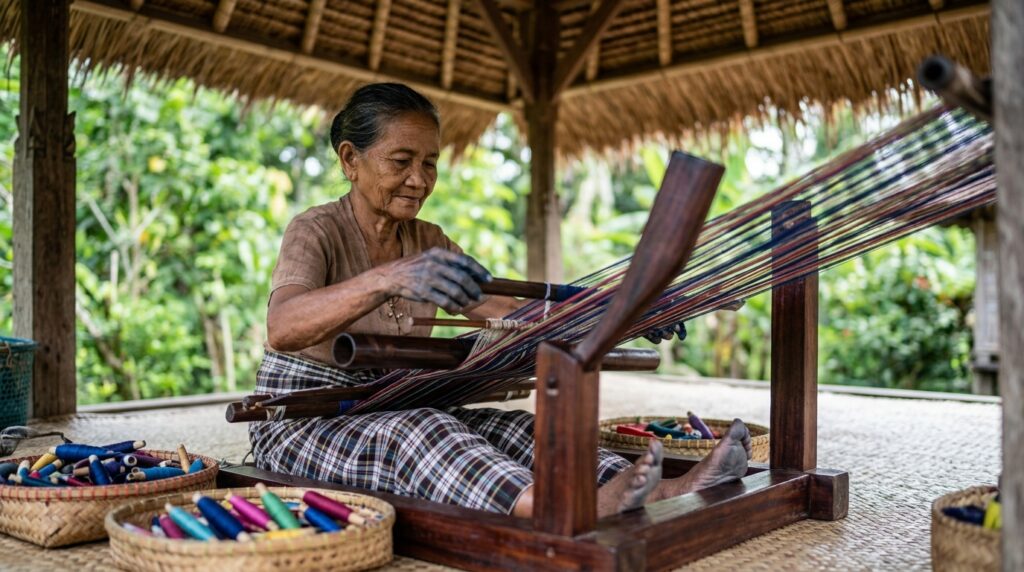
Moving onto the weaving terrace of a century-old earthen home, this technical session challenges you to master the structural mechanics of the traditional Sasak bback loom. Unlike modern rigid frames, this ancient device relies entirely on the weaver’s body mass to create tension. You will sit flat on a woven bamboo mat with your legs extended straight, buckling a thick water-buffalo hide strap behind your lower back to anchor the warp threads. Adjusting your body posture to tighten or loosen the loom layout requires subtle core control and constant focus, transforming the act of weaving into a deeply physical, personal conversation between your body and the wood.
4. The Geometric Songket Inlay Technique
Once your loom is perfectly balanced and pressurized, a master weaver teaches you the intricate art of supplementary weft ornamentation—the defining feature of authentic Sukarara Songket. Working with fine gold and silver metallic threads, you will learn to count the precise number of vertical warp threads to lift using a thin bamboo pick, interlocking the metallic yarn to create the geometric shapes of the Subahnale (sacred) or Kekek (lovebird) patterns. Each row demands absolute concentration and spatial awareness, as a single miscounted thread can disrupt the entire layout. Watching the shimmering, metallic pattern slowly rise from the matte cotton background is a deeply satisfying artistic achievement.
5. The Master Fabric Cleansing Ritual
The final immersion honors the completion of your textile journey with a traditional fabric finishing and washing ritual at the village well. After cutting your woven piece away from the structural loom frame, you will submerge the cloth in a special botanical rinse infused with crushed kaffir lime and wild soap-berries. This natural solution sets the organic plant dyes permanently into the fibers while softening the stiff cotton threads. Spreading the wet cloth to dry across a long bamboo pole in the village square allows you to admire the subtle shifts of your hand-dyed indigo blues and intricate silver geometry, celebrating a tangible piece of Sasak history created under your own power.