- Location: Toapaya Eco-Hinterland, Central Pulau Bintan
Deep within the undulating hills and secondary forests of central Bintan lies the forgotten cradle of the island’s 19th-century global trade boom. Long before the era of modern resorts, Bintan was one of the world’s leading producers of Gambier (Uncaria gambir), a leaf extract highly prized in Europe for tanning leather and dyeing textiles. Today, the jungle has largely reclaimed the massive estates, leaving behind mysterious, moss-covered stone foundations and primitive boiling hearths. These five immersive heritage trails invite you to trek into the green interior to map these industrial ruins before stepping into an open-air workshop to learn the slow, ancient art of extracting raw botanical pigments to dye structural fabrics by hand.
1. The Jungle-Reclaimed Masonry Trek
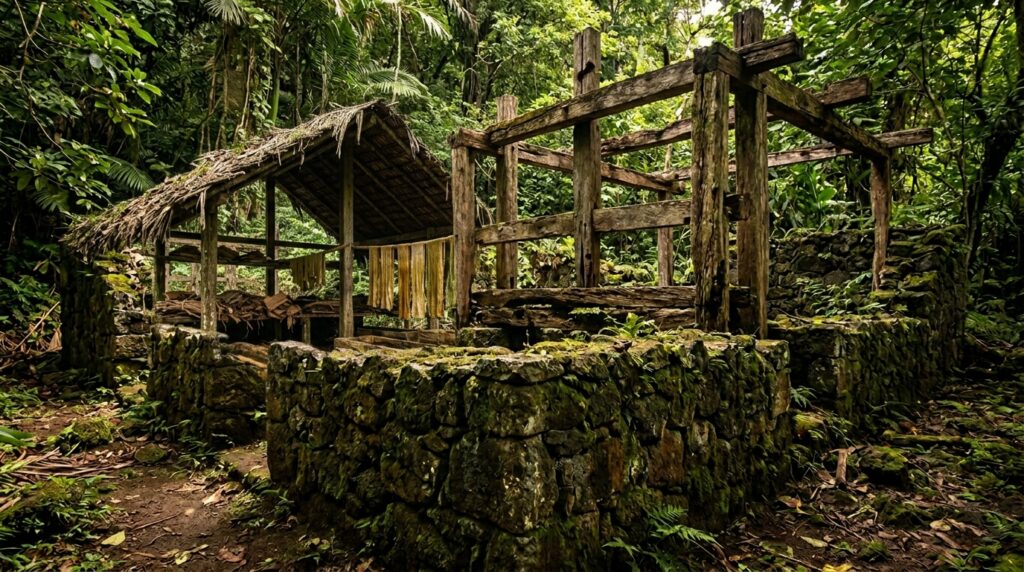
The heritage exploration begins along a narrow, sun-dappled footpath that cuts through the dense secondary jungle of Toapaya. Guided by the crisp, herbal scent of wild ferns and damp soil, you will navigate toward a secluded valley hidden from modern roads. Here, the forest parts to reveal the massive, mortarless granite stone foundations of a 19th-century Chinese-Malay gambier processing factory. Walking slowly among the ruined walls and observing how the roots of giant banyan trees have locked the heavy stones in place creates an immediate, powerful connection to the island’s forgotten industrial frontier.
2. The Volcanic Hearth Geometry Study
Moving into the center of the ruined complex, this architectural segment focuses on the primitive engineering used by early settlers. You will locate the remains of a Bangsal—a massive, circular boiling hearth constructed from local red clay and river stones. This is where tons of gambier leaves were slowly simmered in giant iron vats over a continuous mangrove-wood fire. Tracing the geometric symmetry of the subterranean flues and chimney bases with your hands allows you to appreciate the raw, physical scale of historical manual labor before nature initiated its slow reclamation.
3. The Manual Leaf-Steep Extraction
Transitioning from historical observation to active physical craft, you move to a rustic, open-air timber workshop nearby. Under the guidance of a local cultural archivist, you will participate in the traditional extraction process. You will gather fresh, oval-shaped gambier leaves from heritage bushes, bruise them thoroughly in a deep wooden mortar, and transfer them into a bubbling clay cauldron heated by a low charcoal fire. Watching the clear water slowly transform into a thick, concentrated, resinous paste that glows a deep, earthy terracotta-orange anchors your senses completely in the chemistry of the earth.
4. The Herb-Stained Textile Vat Dip
With the pure botanical pigment extracted, this hands-on artistic segment introduces you to the traditional method of textile tanning. You will be given a large piece of raw, unbleached organic linen. After mapping out minimalist geometric patterns using structural folds, you will submerge the fabric deep into a warm, herb-infused gambier vat. Kneeling beside the wooden tub, you will manually massage the tannin-rich liquid into the fibers for over an hour. The rhythmic, repetitive motion of the soak combined with the rich, astringent aroma of the brew induces a highly focused, meditative state of mind.
5. The Canopy-Line Drying Decompression
The final heritage stage takes place as the late-afternoon sun drops low, casting long, dramatic geometric shadows through the trees. You will hang your freshly dyed, earth-toned linen onto a long clothesline strung between two native wild nutmeg trees, watching the wind catch the damp fabric. While the textile dries under the jungle canopy, you will retreat to a low bamboo bench to enjoy a warm mug of Teh Daun Gambir—a mild, antioxidant-rich herbal infusion made from dried wild leaves and sweetened with wild forest honey. Watching your handmade creation cure in the natural air brings a deeply peaceful, grounding close to your industrial safari.