In a city of relentless movement, true luxury is found in the absence of noise. These five architectural escapes use vast, empty spaces and raw materials to create “Sensory Sanctuaries.” Here, the architecture isn’t just a container for art; it is a tool designed to slow your heart rate and recalibrate your focus through the power of stillness.
1. The Monolithic Void in Kuningan
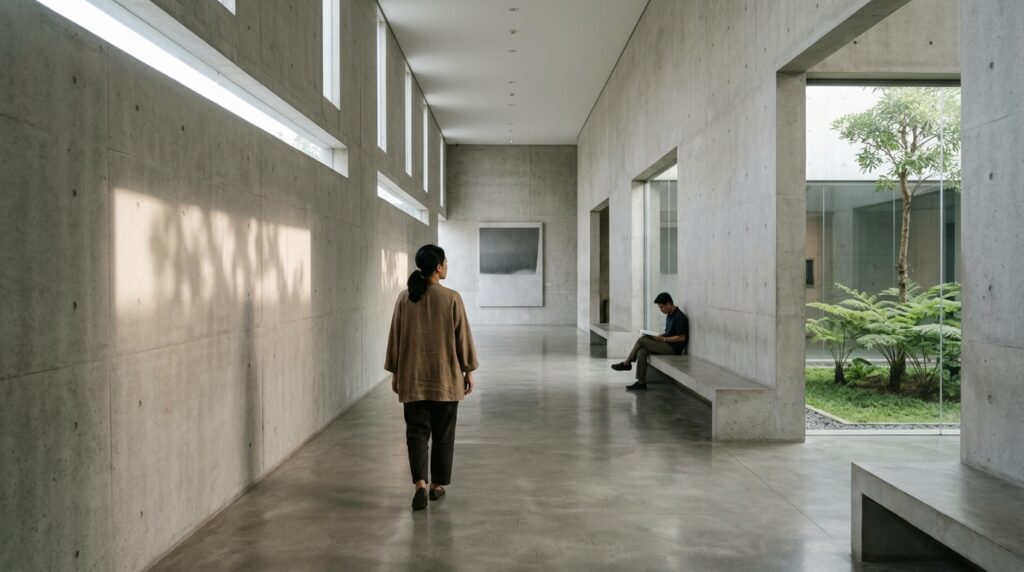
Built entirely from poured-in-place grey concrete, this private gallery feels like a modern cathedral. The entrance is a long, narrow ramp that transitions you from the city’s glare into a dimly lit hall where the only sound is the echo of your own footsteps. There are no windows at eye level—only a continuous skylight along the perimeter that allows a “blade of light” to wash down the walls, highlighting the texture of the concrete and the stillness of the sculptures.
2. The Floating Pavilion at Slipi
This museum is a masterclass in transparency and weightlessness. The main exhibition hall is a glass-and-steel box that seems to hover over a massive, black-tiled reflecting pool. As you walk across the floating bridge to enter, the sound of the city’s traffic is replaced by the gentle lap of water. The interior is a wide-open “white cube” where the boundaries between the indoor art and the outdoor greenery are blurred, creating a tranquil, zero-gravity atmosphere.
3. The Red-Brick Labyrinth in Kebayoran
Inspired by traditional Indonesian masonry but executed with modern geometric precision, this space is a maze of tall, red-brick walls and hidden courtyards. The bricks are laid in a “porous” pattern that allows the breeze to filter through while blocking out the visual chaos of the surrounding neighborhood. It is a place of shadows and tactile surfaces, where the coolness of the clay and the rhythmic patterns of the walls provide a grounding, meditative escape.
4. The Spiral Observatory at Kota Tua
Located within a renovated industrial shell, this museum’s centerpiece is a massive concrete spiral staircase that rises through five floors of open gallery space. There are no internal walls; the art is placed in a way that allows you to see the entire “life” of the building from any floor. The acoustics are engineered to absorb sound, turning the vast volume into a “silent canyon” where you can observe the historical heart of Jakarta in total, peaceful isolation.
5. The Subterranean Garden in Tebet
Hidden beneath a manicured public park, this museum is carved directly into the earth. The galleries are reached via a sunken courtyard filled with moss and ferns, creating a natural temperature drop of several degrees. The underground chambers feature “light wells”—cylindrical openings to the sky—that allow columns of sunlight to illuminate the artifacts. Being underground provides a unique sense of security and detachment, making it the city’s ultimate hideaway for deep, uninterrupted contemplation.