At the easternmost edge of Java lies a landscape that feels less like Earth and more like a fever dream of the subterranean gods. Mount Ijen is not merely a volcano; it is a massive, open-air chemical laboratory where the forces of the tectonic and the atmospheric collide in a display of “The Chemical Sublime.” It is a place of brutal, staggering beauty, defined by an acidic turquoise lake and a phenomenon that defies the conventional imagery of volcanic activity: the Electric Blue Fire.
The Blue Fire: A Kinetic Ghost
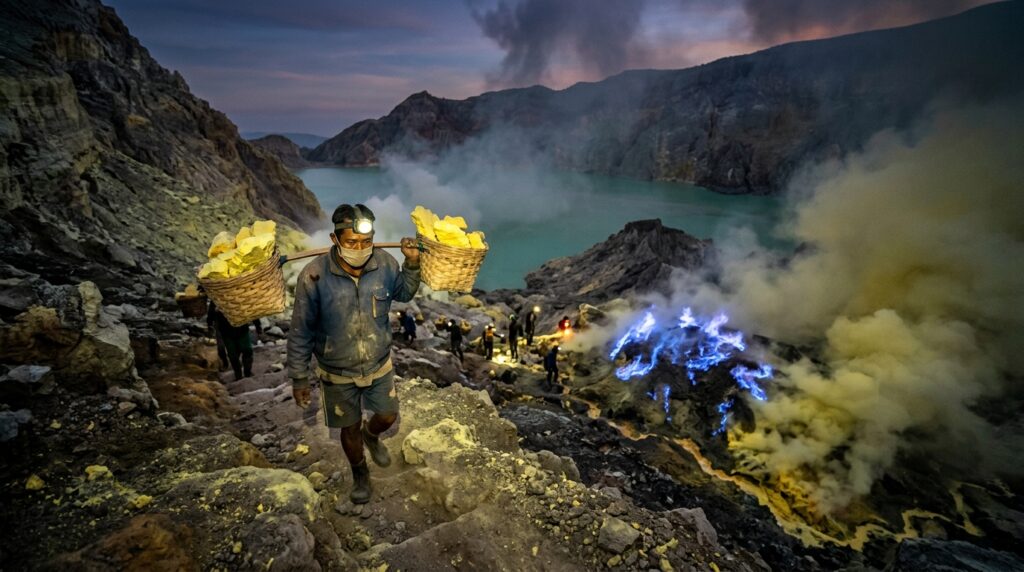
While most volcanoes are associated with the red-orange glow of molten basalt, Ijen’s nocturnal identity is draped in neon blue. This is not lava, but the result of a high-pressure chemical reaction. Sulfuric gases, trapped beneath the earth at temperatures exceeding 600°C, burst through narrow volcanic fissures. Upon contact with the oxygen-rich night air, the gas ignites, creating “electric” flames that can reach up to five meters in height. In the dead of night, these blue fires flow down the crater walls like liquid light, creating a ghostly, kinetic silhouette that represents the earth’s internal energy stripped of its usual earthy tones.
The Acidic Mirror
Cradled within the jagged caldera is the world’s largest highly acidic crater lake. Its vivid turquoise color is a visual deception—a byproduct of extreme concentrations of sulfuric and hydrochloric acids, mixed with dissolved metals. The lake acts as a giant chemical vat, its pH levels low enough to dissolve metal within hours. The contrast between the milky-blue water, the scorched yellow of the sulfur deposits, and the stark grey of the volcanic ash creates a color palette that feels unnatural, almost radioactive. The steam rising from the surface isn’t mist; it is a caustic vapor that constantly reshapes the surrounding rock.
The Labor of the Charnel Ground
Amidst this surrealist landscape, the human element introduces a layer of raw, visceral reality. Sulfur miners descend into the belly of the crater daily, moving through thick, suffocating plumes of toxic smoke. Here, they harvest “Devil’s Gold”—solidified sulfur that has cooled from a molten blood-red liquid into brittle, bright yellow slabs. Without the aid of modern machinery, these men carry bamboo baskets weighing up to 90 kilograms on their shoulders, navigating the steep, treacherous ascent out of the crater. It is a scene of industrial-era labor surviving in the heart of a geological nightmare, a testament to human endurance against a backdrop of chemical hostility.
The Architecture of Chaos
The landscape of Ijen is one of constant erosion and deposition. The “pipes” installed by miners to channel the sulfuric gases become encrusted in layers of crystalline sulfur, creating strange, organic architectures that look like alien coral reefs. The air itself is a heavy, tangible presence, smelling of rotten eggs and scorched earth, a sensory reminder of the volcano’s active metabolism. Every surface is coated in fine yellow dust, and the jagged rocks are scarred by the constant flow of acidic condensate.
A Confrontation with the Primordial
To stand on the rim of Ijen is to witness the earth in a state of perpetual becoming. It is a place where the boundaries between solid, liquid, and gas are blurred by extreme heat and acidity. The Chemical Sublime at Mount Ijen is not a peaceful beauty; it is a beauty born of violence, toxicity, and the terrifying scale of planetary forces. It serves as a reminder that beneath the thin crust of our habitable world, there exists a chaotic, glowing reality that operates on a logic entirely its own—a world of blue fire and yellow stone that remains one of the most alien environments on the face of the planet.