- Location: Bayan Beleq Village, North Lombok
Nestled on the cool, emerald-green foothills of Mount Rinjani, Bayan is the spiritual cradle of Lombok’s indigenous Wetu Telu heritage—a unique historical synthesis of ancient Sasak customs, Hinduism, and early Islamic philosophy. Far removed from the bustling beach towns, this mountain community has fiercely preserved its architectural and literary anchors for over five centuries. These five immersive heritage journeys take you past terraced rice fields and into sacred bamboo compounds, where you will sit on woven grass mats with traditional elders to explore ancient architectural engineering and listen to the rhythmic chanting of centuries-old palm-leaf manuscripts.
1. The Woven Bamboo Architecture Trail
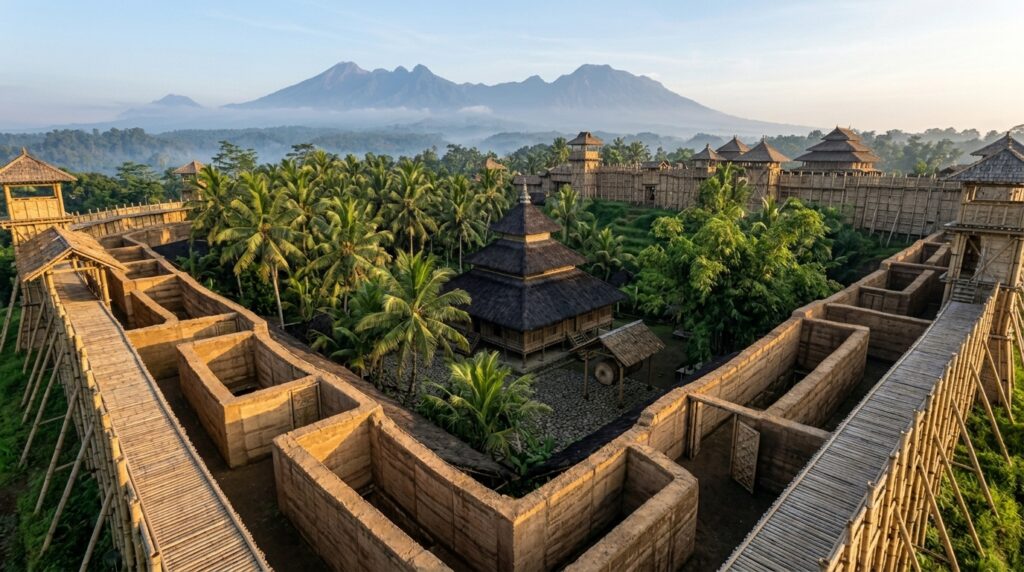
This architectural exploration centers on the Masjid Kuno Bayan Beleq, one of the oldest places of worship in Indonesia, standing since the 16th century. Led by an indigenous cultural guardian, you will examine the building’s brilliant, mortar-free construction: walls woven entirely from thick bambu belah (split bamboo) and a high-pitched roof thatched with rumbia (sago palm) leaves, all resting on a foundational platform of river stones. The structure uses no nails, relying instead on intricate rattan bindings that allow the building to flex and survive the island’s frequent earthquakes. Photographing the soft light filtering through the bamboo weave reveals a timeless masterpiece of sustainable tribal engineering.
2. The Lontar Takepan Chanting Circle
Set inside the shaded veranda of a traditional Sankep (village council pavilion), this intimate session invites you into the world of ancient Sasak literature. You will join the Pujangga (master manuscript readers) as they unwrap a sacred Takepan—a manuscript meticulously etched into dried palmyra palm leaves (lontar), bound by cords, and preserved with natural hazelnut oil. As the elders delicately run their fingers over the ancient Kawi script, they begin the Membaca Lontar, a mesmerizing, rhythmic chanting ritual that translates centuries-old philosophies, moral codes, and origin stories into modern Sasak verse. Listening to the melodic, undulating voices under the quiet canopy of the village is a deeply hypnotic cultural immersion.
3. The Sacred Earthen Flooring Ritual
This hands-on workshop takes you inside a Bale Tani (traditional Sasak residential house) to understand the unique domestic heritage of Bayan. The floors of these ancient structures are made without concrete; instead, they are crafted from a specialized mixture of wet clay, rice husks, and fresh cow manure. Under the guidance of a village elder, you will participate in the maintenance ritual, smoothing a fresh layer of the organic mixture onto the earth floorboard. Once dry, the floor becomes incredibly hard, completely odorless, dust-free, and naturally repels insects while keeping the interior cool in the tropical heat, offering a fascinating lesson in vernacular home design.
4. The Ancestral Palm-Oil Ink Studio
Before a story can be carved onto a palm leaf, the materials must be painstakingly prepared. This creative heritage session guides you through the traditional production of Sari Mangsi—the rich, indelible black ink used to highlight the engravings on lontar leaves. You will assist local artisans in burning candlenuts and collecting the pure soot on the underside of a clay pot, then mixing the fine carbon with pure coconut oil. Using a sharp iron stylus (pengutik), you will practice etching a single geometric Sasak motif onto a prepared palm leaf, rubbing your handmade ink over the surface to watch the design instantly pop into sharp, black relief.
5. The Spring-Water Ancestral Blessing
The final heritage journey takes place during the quiet hours of late afternoon at the Gedeng Lokaq, a protected ancestral spring hidden within a dense grove of giant bamboo at the edge of the village. For generations, the people of Bayan have used these crystal-clear, mineral-rich waters for spiritual cleansing rituals before major agricultural and religious festivals. Sitting on a smooth volcanic stone while an elder dips a bundle of wild alang-alang grass into the spring to gently sprinkle water over your head and hands provides a refreshing, deeply peaceful conclusion to your historical journey into the heart of northern Lombok.