The Marine Forest Sanctuary
Navigating the narrow, saltwater channels of Gili Sulat—an uninhabited mangrove island off the northeast coast of Lombok—completely isolates you from the typical beach resort landscape. The environment is defined by a dense, tangled wilderness of ancient mangrove trees whose complex, arching root systems plunge deep into the clear, shallow sea. Drifting through these quiet marine corridors in a small, non-motorized wooden canoe forces you to adapt to the slow, silent rhythm of the tidal flow. The air is thick with the scent of saltwater and rich coastal soil, broken only by the occasional splash of a jumping fish or the calls of migratory seabirds nesting in the high canopy. Immersing yourself in this pristine blue-carbon ecosystem completely resets your sensory boundaries, pulling your mind away from urban metrics and locking it into the survival mechanics of a living coastal barrier.
The Engineering of Sustainable Bamboo Architecture
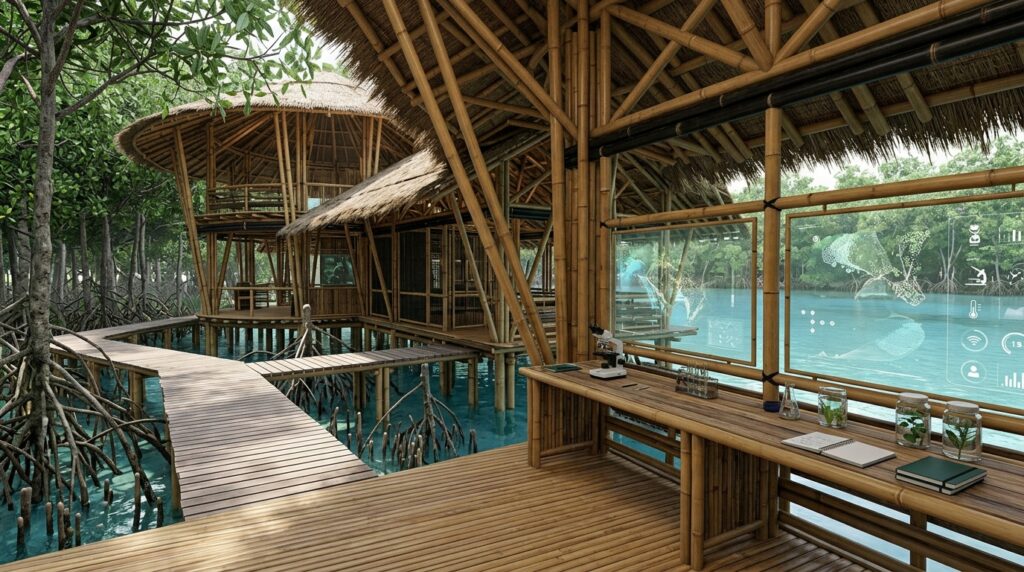
The connection between nature and human design becomes clear when you step off the water and onto the island’s low-impact eco-research station, constructed entirely from local bamboo and sustainably sourced thatch. Sitting inside the open-air pavilion allows you to analyze how lightweight, flexible materials can be engineered to withstand harsh, corrosive marine environments without the use of heavy concrete foundations or toxic chemical treatments. You observe the intricate joinery techniques, where thick bamboo poles are lashed together using traditional fiber ropes and secure wooden pins, allowing the entire structure to flex safely with the powerful ocean winds rather than resisting them rigidly. The design prioritizes complete structural transparency, showing how a building can provide shelter while remaining entirely breathable, eco-friendly, and visually harmonious with the surrounding coastal forest.
The Integration of Tidal Architecture and Conservation
Analyzing how a structure interacts with a changing shoreline requires looking closely at how it adapts to the daily movement of the sea. You study how the entire pavilion and its connecting boardwalks are raised high on slender, vertical bamboo stilts, mimicking the natural root structures of the surrounding mangroves to let high tides pass completely underneath without causing structural damage or disturbing the fragile seabed ecosystem. Next, you evaluate the passive cooling layout, noting how the sweeping, hyper-parabolic roof design catches the slightest sea breeze from any direction and funnels it downward to naturally cool the deck without relying on electricity. Finally, you track how the station handles waste, observing the self-contained, dry-composting systems and elevated boardwalk patterns designed to give researchers and visitors full access to the mangrove interior while ensuring not a single footstep compresses the delicate mudflats below.