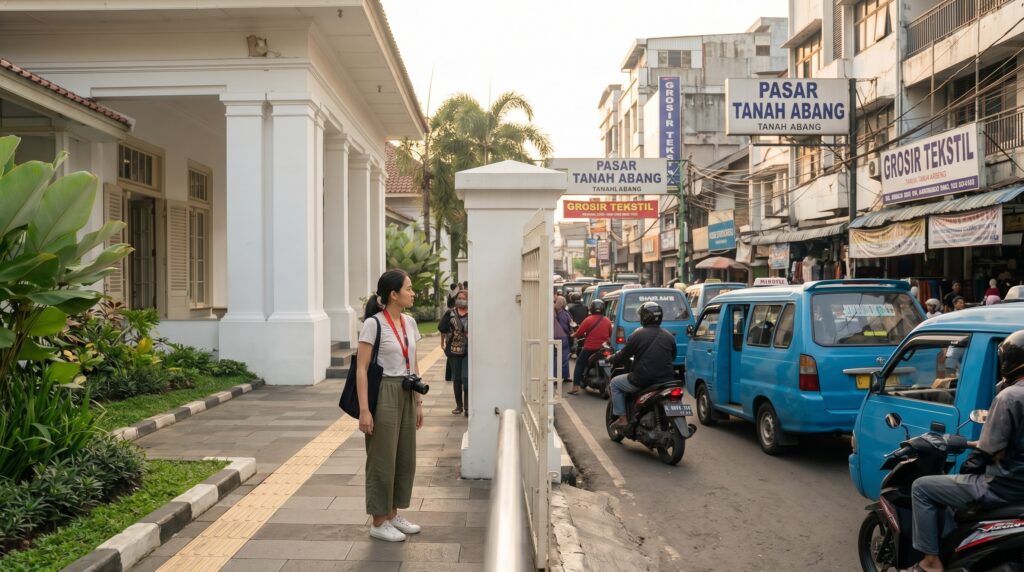
Situated on the fringes of the bustling Tanah Abang textile district, the Museum Tekstil is a quiet “Heritage Sanctuary” housed in a grand 19th-century colonial villa. While the surrounding area is known for modern commerce, this museum serves as a high-fidelity archive of Indonesia’s soul, woven into fabric. The architecture of the main building, with its high ceilings and expansive verandas, provides a cool “Escape” where visitors can explore the technical evolution of weaving and dyeing across the archipelago.
I. The “Batik Gallery” and the Evolution of Motifs
The heart of the museum is the Batik Gallery, which showcases a rotating collection of rare and antique cloths. From the royal Batik Keraton of Yogyakarta to the vibrant, European-influenced Batik Pesisir of the north coast, the “Discovery” here lies in the symbolism of the patterns. Every dot (titik) and line is a technical feat of hand-waxing. Observing the transition from natural dyes to chemical pigments offers a high-fidelity look at how global trade influenced Indonesian aesthetics, turning simple garments into complex historical records.
II. The Botanical Garden of Natural Dyes
Behind the main villa is a unique “Living Laboratory”—a botanical garden dedicated to the plants used in traditional dyeing. This is a “Technical Deep-Dive” into the chemistry of nature. Visitors can identify the Indigofera plants used for deep blues, Morinda roots for reds, and mahogany bark for browns. This garden is essential for understanding the “Slow Fashion” philosophy of the past, where the creation of a single color could take months of preparation, highlighting the high-fidelity connection between the Indonesian landscape and its craft.
III. Hands-On Mastery: The Batik-Making Workshop
One of the most engaging “Experiences” at the museum is the on-site workshop located in a pavilion at the rear. For a small fee, you can sit behind a gawangan (wooden frame) and learn the technical art of Batik Tulis. Using a canting (wax pen) to apply hot liquid wax requires a level of focus and hand-eye coordination that provides a “Mindful Reset.” This hands-on session transforms the museum visit from passive observation into a tactile “Adventure,” giving you a profound respect for the artisans who spend lifetimes mastering this craft.
IV. The Library and Textile Conservation Lab
For the serious researcher or “Heritage Explorer,” the museum houses a specialized library and a conservation laboratory. These facilities are dedicated to the technical preservation of fragile fibers. The “Logistics” of conservation involve controlling humidity and light exposure to prevent the degradation of centuries-old silk and cotton. Seeing the precision tools used to repair and maintain these artifacts provides a high-fidelity understanding of the museum’s role as a guardian of national identity, ensuring that these “Woven Stories” survive for future generations.
V. A Contrast of Two Worlds: From Museum to Market
The logistics of your visit are best planned by contrasting the museum’s serenity with the high-energy chaos of the Tanah Abang Market just a few blocks away. Walking from the quiet, shaded gardens of the museum into the largest textile market in Southeast Asia is a powerful “Perspective Shift.” It allows you to see the modern endpoint of the traditions you just studied. This journey from the “Heritage Root” to the “Commercial Peak” makes Museum Tekstil an essential anchor for anyone looking to understand the true fabric of Jakarta’s lifestyle.