In an era of mass-produced glass and steel, Sumba stands as a defiant monument to the Original Form. This is a land where the term “minimalism” is not a modern trend, but an ancient law of survival and dignity. The Marapu culture has perfected an aesthetic of “Primitive Minimalism”—a philosophy where every structure, every fabric, and every gesture is a direct conversation with the earth and the spirits. This is a journey to a landscape of raw power, where luxury is redefined as the privilege of experiencing life in its most unadulterated state.
I. The Vertical Horizon: The Geometry of the Uma Mbatangu
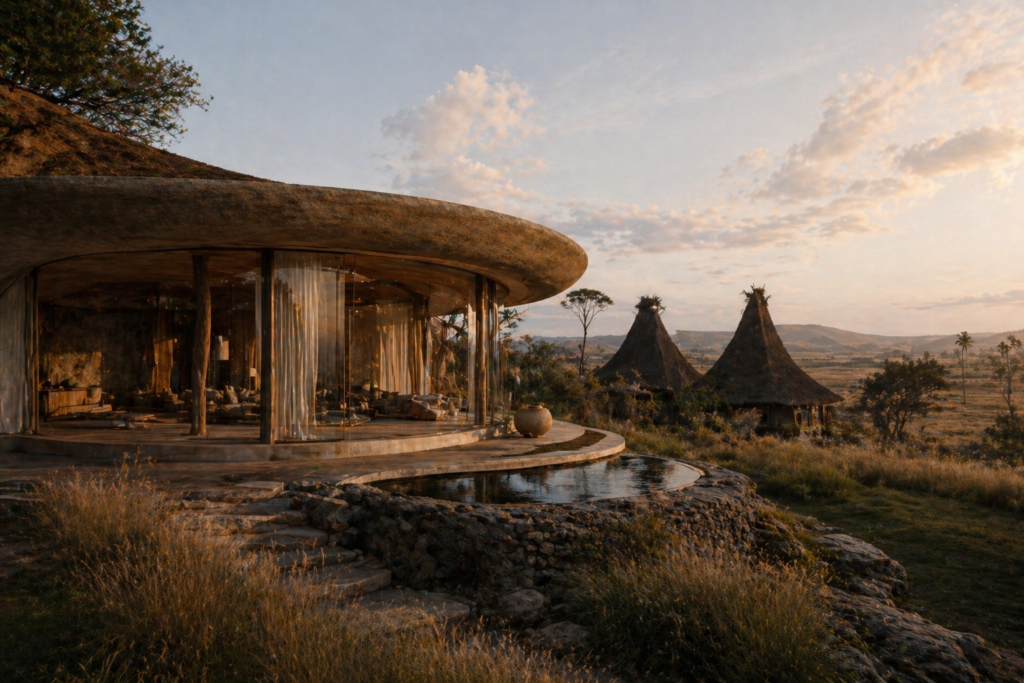
The silhouette of a Sumba village is unlike any other on Earth. High-pitched, thatched roofs known as Uma Mbatangu pierce the sky, designed to house the spirits of ancestors in their towering peaks. These structures are masterclasses in organic engineering: built entirely from bamboo, cogon grass, and wooden beams, held together by intricate lashings without a single metal nail.
The luxury here is found in the verticality and the scent. Inside these towering homes, the air carries the scent of ancient woodsmoke and dried grass. The light filters through the thatch in golden needles, illuminating a space that feels vast yet deeply protective. To stand beneath these roofs is to understand that true architectural prestige comes from the height of one’s spirit and the strength of one’s roots.
II. The Textile of Time: The Alchemy of Sumba Ikat
Sumba is world-renowned for its Ikat textiles, but to see them in their birthplace is to witness a slow-motion alchemy. These fabrics are not merely clothing; they are woven manuscripts of tribal history. Using only natural dyes—deep indigo from plants and rusty reds from kombu roots—the weavers spend months, sometimes years, creating a single piece.
The luxury here is the weight of time. In a “Primitive Minimalist” world, we value the imperfection of the hand-made over the precision of the machine. Touching a piece of Sumba Ikat is a tactile experience of the savanna itself—the coarseness of the hand-spun cotton and the earthy depth of the pigments. It is the luxury of wearing a story that took a lifetime to tell.
III. The Gallop of Freedom: The Wild Savannas and Sea Cliffs
The landscape of Sumba is a minimalist masterpiece of gold and blue. Vast, undulating lime-stone savannas turn from emerald green in the monsoon to a sun-scorched gold in the dry season, eventually dropping off into the violent, crashing turquoise of the Indian Ocean.
The defining experience of this frontier is the Sumba Horse. These small but incredibly sturdy spirits are the heartbeat of the island. Watching a herd of wild horses gallop across a deserted white-sand beach at low tide is a visual symphony of raw power. There is no fence, no boundary, and no pretense. Here, luxury is the feeling of absolute, untamed freedom—a moment where man, animal, and earth are stripped of everything but their shared breath.
IV. The Megalithic Silence: Living Among the Stone Guardians
In the center of the villages, massive dolmens and carved stone tombs stand as silent guardians. Sumba is one of the last places on Earth where a megalithic culture is still very much alive. These stones are not relics of the past; they are the center of the present.
The luxury here is the gravity of the silence. There is a profound weight to a landscape dotted with giant stones carved by hand. It creates an atmosphere of “Ancestral Minimalism”—where the noise of the modern world is drowned out by the heavy, silent presence of the past. It invites a stillness of the mind that is impossible to find in the neon-lit corridors of a city.