
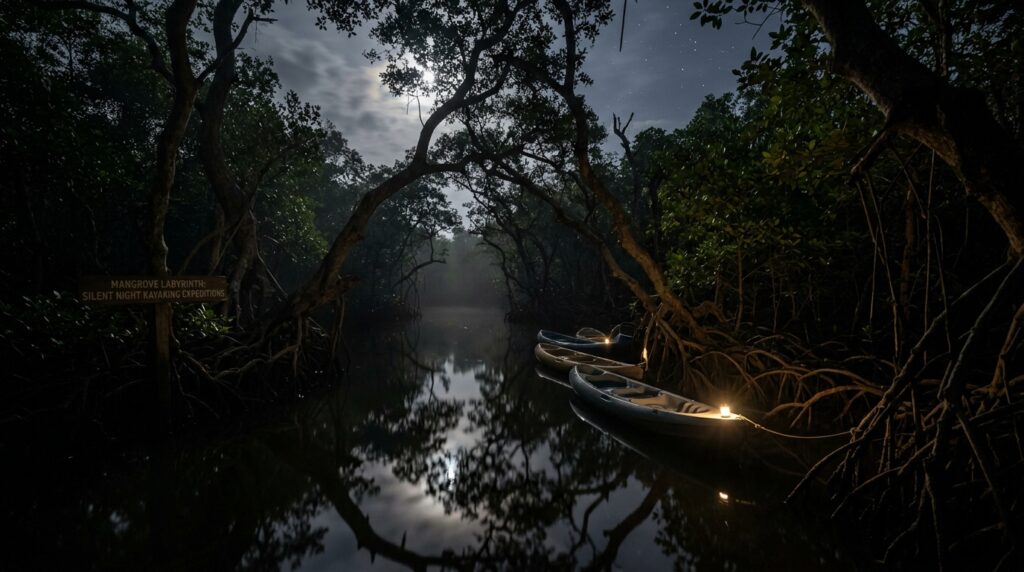
While the daytime reveals the vibrant green beauty of Bintan’s waterways, the true mystery of the mangrove forest awakens after the sun goes down. The Kawal River estuary, snaking through the quiet eastern district of Pulau Bintan, is a dense, twisting network of tidal channels that becomes an absolute sanctuary of darkness and silence at night. These five night kayaking expeditions invite you to paddle into this deep wilderness under the stars, using silent paddles to explore a hidden world where the water glows with living light and the trees flicker with thousands of nocturnal insects.
1. The Bioluminescent Paddle
Launching from the quiet muddy banks of the Kawal fishing docks just after the last twilight fades, you steer your kayak into the pitch-black river channel. As your plastic paddle blade cuts through the dark water, the river suddenly flashes with a brilliant, neon-blue light caused by millions of microscopic dinoflagellates. Every stroke of your paddle leaves a glowing trail of liquid light, and the wake of your kayak illuminates the submerged roots of the mangrove trees like a modern art installation. It is a breathtaking, magical immersion into natural chemistry, where every movement you make creates a beautiful display of light in the dark water.
2. The Canopy Tunnel Crawl
This technical route takes you away from the main river channel and into the narrowest, most secluded tidal creeks of eastern Bintan, where the ancient mangrove trees lean over to interlock their branches overhead. Navigating this dark, enclosed tunnel requires a slow, deliberate pace, using your hands to gently push off the smooth bark of the trees to guide your kayak forward. The thick canopy completely blocks out the starlight, creating an absolute darkness that heightens your other senses. Listening to the deep pop of mud crabs, the rustle of hidden night birds, and the steady drip of water from the leaves creates an intense, thrilling connection to the wild interior.
3. The Firefly Confluence
Following the winding river to a secret point where a freshwater spring meets the brackish Kawal estuary, this expedition leads you to a massive congregation of local fireflies. Turning off all flashlights, you let your kayak drift silently into a wide pool bordered by ancient Berembang trees. Within seconds, your eyes adjust to reveal thousands of tiny, synchronized yellow and green lights flashing in perfect harmony across the leaves, mimicking the display of holiday decorations. The silent, rhythmic blinking of the insects reflecting on the glass-flat surface of the river creates a dreamlike environment, forcing your mind to slow down and focus on the delicate details of nature.
4. The Midnight Sandbar Rest
Timed to coincide with the extreme low tide of the midnight moon, this route guides you to a large, temporary sandbar that rises from the center of the Kawal River basin. You can pull your kayak onto the wet sand and step out onto the temporary island, completely surrounded by the dark, whispering forest walls. Sitting on the sandbar in the absolute middle of the river, with the cool night air rolling down from the inland Bintan hills and the dark water parting around your small island, offers a profound sense of isolation and peace, far removed from the busy modern coast.
5. The Estuary Echo Safari
The final night trail follows the widening mouth of the river where the Kawal estuary empties into the open sea along Jalan Pantai Trikora, an area where the acoustic property of the forest changes dramatically. If you stop paddling and remain perfectly still in the center of the bay, the dense root walls act as a natural acoustic dish, capturing and echoing the distant sounds of the breaking ocean surf miles away. Listening to the deep, muffled roar of the South China Sea bouncing softly through the mangrove corridors while you float in a silent, dark river provides a beautiful, high-contrast auditory conclusion to your night journey across the island’s interior.