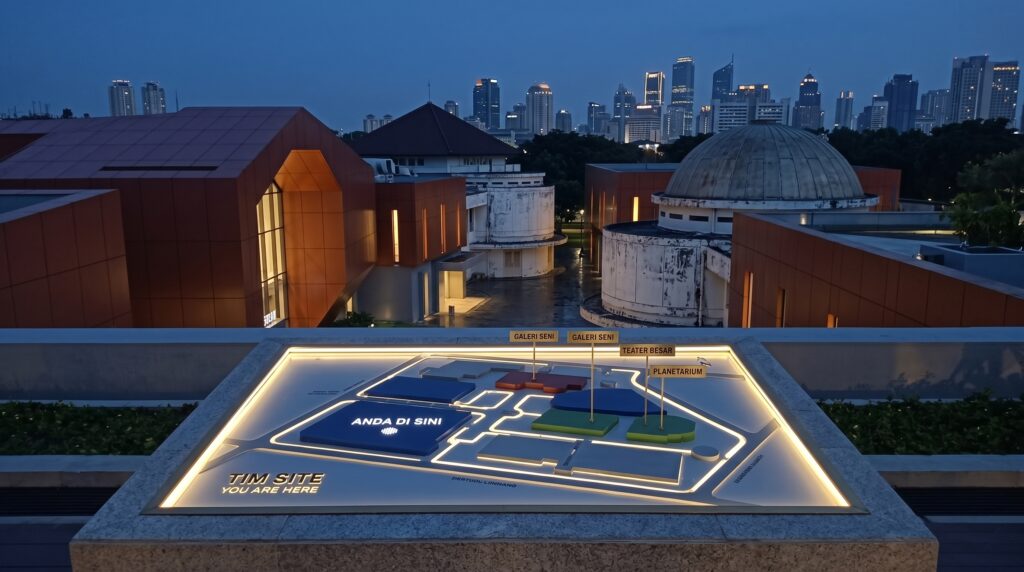
The revitalization of Taman Ismail Marzuki (TIM) has transformed this historic complex into a “High-Fidelity” cultural sanctuary. Located in the heart of Cikini, the new TIM is a masterpiece of modern architecture that respects its urban roots. The design, led by architect Andra Matin, incorporates a “Long-House” concept inspired by traditional Indonesian forms, wrapping the library and art galleries in a rhythmic, slatted facade that mimics the lines of a music score. For the modern explorer, TIM is the ultimate “Urban Discovery” where art, science, and heritage intersect.
I. The Architectural Marvel of the Oeripan Library
The centerpiece of the complex is the Jakarta Library, housed within the long, ship-like building that spans the front of the site. The architecture utilizes a “Split-Level” design, creating open, airy spaces that allow natural light to filter through the wooden slats. This isn’t just a place for books; it’s a “Wellness Space” for the mind. The technical precision of the interior—with its vast reading lofts and minimalist wood finishes—provides a quiet, high-fidelity environment for study and reflection, offering a stark contrast to the busy streets of Cikini just outside.
II. The Planetarium: A Scientific Anchor
While the exterior has been modernized, the Jakarta Planetarium and Observatory remains a beloved scientific landmark within the complex. Historically one of the oldest in Southeast Asia, it serves as a bridge between art and science. The logistics of visiting involve checking the schedule for star-gazing sessions or digital sky shows. The dome itself is a feat of mid-century engineering, and its preservation within the new, ultra-modern park provides a “Timeline Connection” that honors Jakarta’s long-standing commitment to public education and space exploration.
III. Contemporary Galleries and the “Creative Hub”
The Galeri Seni (Art Gallery) and Annex buildings are designed with a “Blank Canvas” philosophy. These high-ceilinged, industrial spaces host a rotating schedule of contemporary Indonesian art, from large-scale installations to fine photography. The “Discovery” here is the flow; the galleries are interconnected by wide, open corridors and outdoor ramps that encourage visitors to wander aimlessly. This layout promotes a “Creative Pulse,” where you might stumble upon a live performance-art piece or an outdoor sculpture exhibition while simply walking to the theater.
IV. The “Urban Forest” and Public Amphitheaters
A major technical achievement of the TIM restoration is the elevation of green spaces. Much of the complex is built on top of integrated parking and service levels, allowing the ground floor and rooftop levels to be converted into an “Urban Forest.” These areas feature native trees and tiered stone seating that act as open-air amphitheaters. It is a “Social Escape” where local students, artists, and families gather. The strategic use of “Bio-swales” and permeable paving ensures that the park helps with Jakarta’s drainage, making it as functional as it is beautiful.
V. Cikini’s Culinary and Cultural Integration
The logistics of a visit to TIM are incomplete without exploring the surrounding Cikini neighborhood. The complex is designed to be “Porous,” meaning it bleeds into the streetscape, making it easy to walk to legendary nearby spots like Gado-Gado Bon Bin or the historic Toko Merah. This integration makes TIM more than just a destination—it is an anchor for “Urban Lifestyle.” Ending a day of gallery-hopping with a coffee at one of the boutique cafes facing the complex allows you to soak in the high-fidelity atmosphere of a city that is successfully blending its past with a sophisticated future.