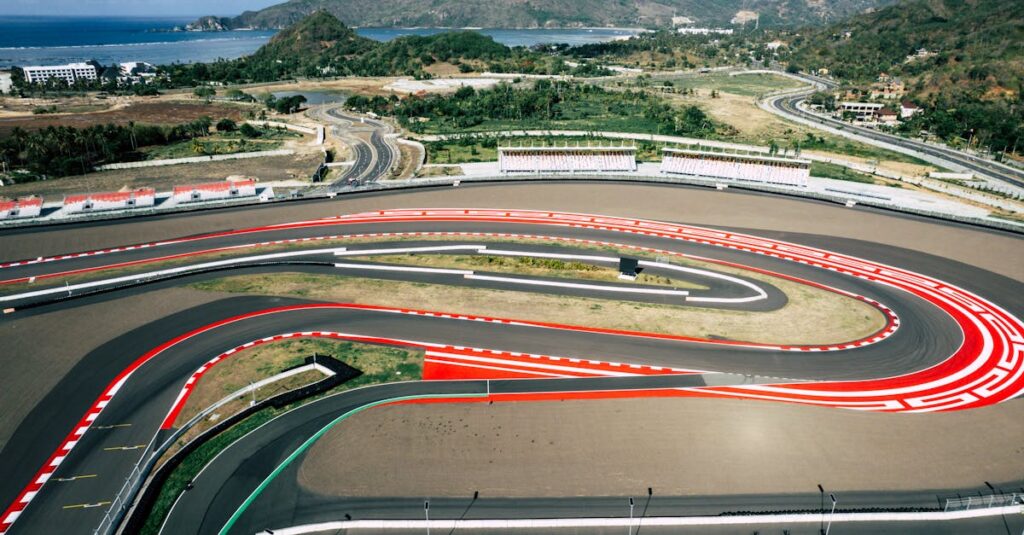
The Mandalika Special Economic Zone (KEK) represents a massive shift in Indonesia’s approach to coastal urbanism. Spanning over 1,175 hectares, this project is not just a circuit destination but a master-planned integration of high-end tourism and community-centric public spaces. The architecture here is a “Modern-Sasak” hybrid, where high-performance engineering meets the traditional curves of Lombok’s heritage. Exploring this zone reveals a strategic layout designed for both the high-speed energy of international racing and the slow-paced rhythm of a tropical “Escape.”
I. The Kuta Beach Park: A Public Canvas
The heart of the waterfront is the Kuta Beach Park, a sprawling public plaza that serves as the gateway to the ocean. The architecture is defined by the Bazaar Mandalika, a structure that mimics the traditional Lumbung (rice granary) shape but utilizes modern steel and open-air ventilation. This space is strategically designed to host local artisans while providing shade for visitors. The layout encourages a seamless flow from the parking zones to the white sands, ensuring that the “Discovery” of the beach remains accessible and unobstructed by heavy commercial barriers.
II. The Strategic Design of the Main Promenade
Stretching along the coastline is the Mandalika Promenade, a wide, pedestrian-friendly artery paved with premium natural stone. This isn’t just a walkway; it’s a high-fidelity vantage point designed to showcase the contrast between the turquoise water and the rugged hills. The promenade features integrated green belts and “pocket parks” that act as natural cooling zones. Its linear design ensures that whether you are jogging at dawn or taking a sunset stroll, you are constantly connected to the coastline’s horizon, providing a mental “Reset” in a world-class urban environment.
III. Pedestrian Connectivity to Local Cultural Hubs
One of the most impressive feats of the Mandalika master plan is its connectivity. Well-marked pedestrian access points and cycling lanes bridge the gap between the modern international circuit area and the vibrant local cultural hubs of Kuta village. This allows for a “Cultural Immersion” where visitors can easily transition from the high-tech atmosphere of the paddock to the traditional markets and local warungs. This integration ensures that the economic benefits of the KEK flow directly into the community, creating a sustainable ecosystem of tourism.
IV. The Landmark Landmark: Merese Hill Integration
The architectural philosophy of Mandalika extends to its natural boundaries, most notably the integration with Merese Hill. The trails leading up from the waterfront are designed to be low-impact, preserving the natural silhouette of the headlands. From the summit, you can see the entire KEK layout—a bird’s-eye view of how the man-made structures respect the natural curvature of the bay. It is the ultimate “Perspective Shift,” seeing the marriage of a billionaire-dollar development with a landscape that has remained unchanged for millennia.
V. Sustainable Urbanism and Future Infrastructure
Mandalika is built with a “Future-Proof” mindset. The zone incorporates advanced water management systems and solar-powered street lighting to minimize its ecological footprint. The use of drought-resistant local flora in the landscaping ensures that the park stays green even during the dry season without excessive water consumption. Staying or walking through this zone provides a glimpse into the future of Indonesian luxury—where high-fidelity infrastructure and environmental consciousness exist in perfect, breathtaking harmony.