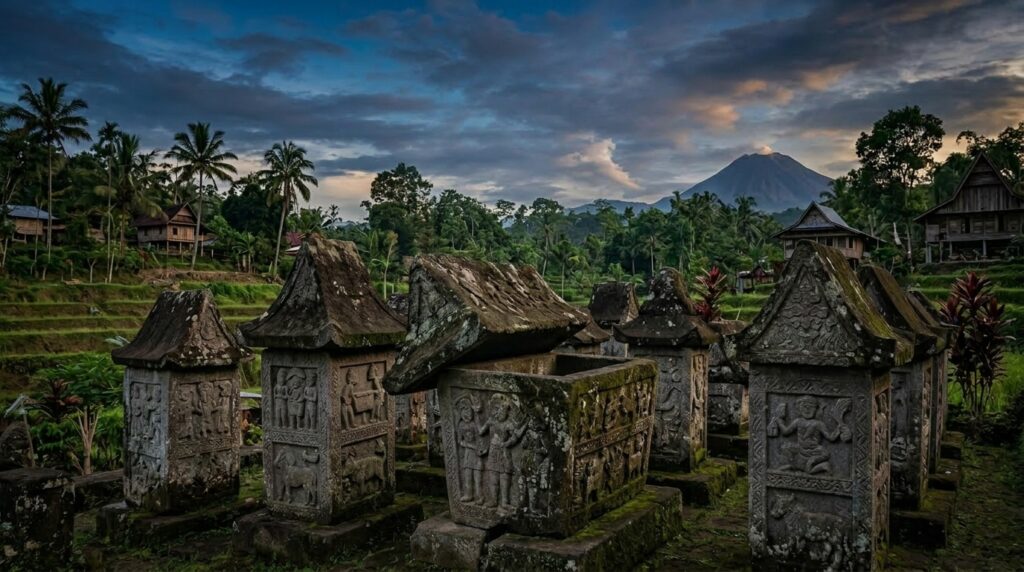
They stand in the highlands of North Sulawesi like a silent, miniature city carved from the bones of the earth. These are the Waruga—monolithic tombs of the Minahasa people that reject the traditional horizontal grave in favor of a vertical, house-like sanctuary. Every block of volcanic tuff is a masterclass in subtractive masonry, where a single stone is hollowed out to create a permanent vessel for the spirit, standing defiant against the humid decay of the tropics.
The true power of the Waruga lies in its internal dimensions. Inside, the deceased was not laid to rest, but sat in a strict fetal position, knees pulled to the chest. This is the Geometry of the Return. To the ancient Minahasa, death was not a linear exit but a biological loop. By forcing the body back into the posture of the unborn, the stone tomb transforms into a literal womb. It is an architectural promise of rebirth, ensuring that the soul is prepared for its next cycle in the same position it entered this one.
Everything about these stones is deliberate. The heavy, pitched lids—carved to resemble ancestral homes—are always oriented toward the North. This isn’t a random placement; it is a spiritual compass. The North is the direction of the “origin,” the place where the ancestors first descended. By aligning the tombs to this axis, the living created a permanent link between the present and the primordial past.
On the surface of the lids, the stone comes alive with bas-relief biographies. Hunters, warriors, and mothers are immortalized in the volcanic rock, their identities etched in primitive, flowing lines that contrast with the rigid, heavy mass of the tomb. These carvings serve as a visual ledger for the community, a way to keep the ancestors’ stories visible while their physical forms are tucked away in a fetal silence.
Walking through a field of Waruga is an experience in megalithic urbanism. These aren’t scattered graves; they are clusters that mimic the density of a village. The moss-covered rock and the stoic, repetitive shapes create a landscape of absolute stillness. It is a place where architecture is used to freeze time, holding the dead in a permanent state of readiness, waiting for the circle of life to complete its turn.