
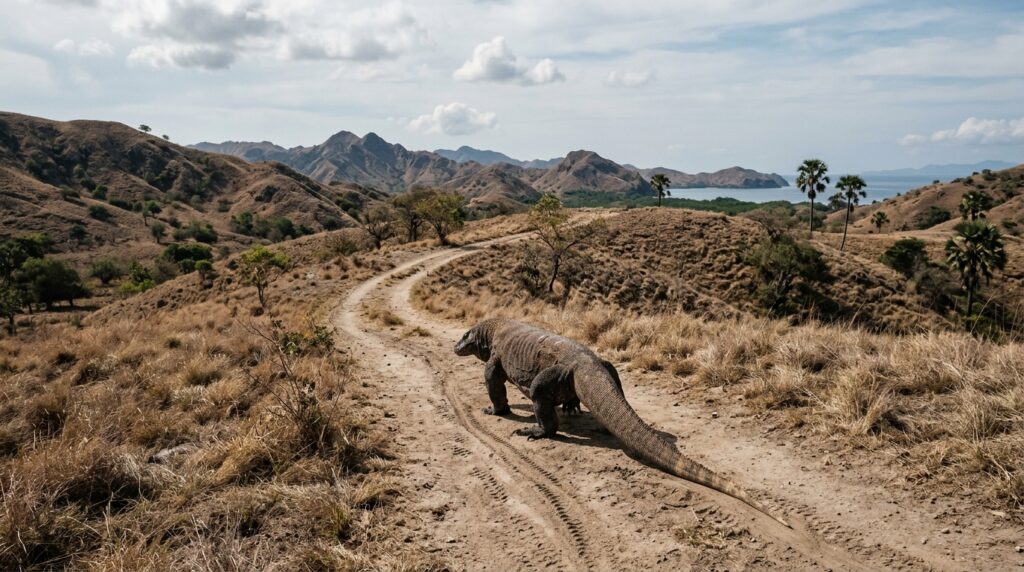
Rising from the deep turquoise currents of the Flores Sea, the Komodo archipelago serves as a jagged, sun-bleached sanctuary for a creature that seems to have crawled straight out of the Pleistocene. This is the realm of the Varanus komodoensis, the last of the true dragons. But the dragon is only half the story; the true power of this place lies in the Reptilian Landscape itself—a harsh, prehistoric environment that has shaped, and been shaped by, its apex predator for nearly four million years.
The islands of Komodo, Rinca, and Padar reject the lush, emerald tropes of tropical Indonesia. Instead, they present a world of “Beautiful Hostility.” During the long dry season, the archipelago undergoes a dramatic metamorphosis. The jungle retreats, and the rolling hills turn a deep, parched bronze. From a distance, the undulating ridges of the islands look like the spine of a massive, sleeping beast. The texture of the land—cracked earth, dry savannah grass, and jagged volcanic rock—perfectly mimics the rugged, armored hide of the Komodo dragons themselves. It is a rare instance where the geography and the biology of a place have achieved a total aesthetic union.
Survival here is dictated by the Aesthetics of Scarcity. In this arid ecosystem, the dragons have evolved a masterclass in biological efficiency. They are patient hunters, blending seamlessly into the shadows of the dry Lontar palms. These palms, with their tall, fan-like fronds, are the only vertical sentinels in a landscape of horizontal heat. They stand as remnants of an ancient flora, surviving in a soil that offers little but minerals and dust. The silence of the savanna is absolute, broken only by the dry rustle of yellow grass or the heavy, rhythmic hiss of a three-meter lizard patrolling its territory.
The coastlines provide a stark, chromatic contrast to the scorched interior. Volcanic activity and the grinding of red organ pipe coral have created beaches of surreal pink and stark white, meeting a sea that is a violent, electric blue. Yet, even at the water’s edge, the reptilian influence remains. The dragons are powerful swimmers, often seen patrolling the shorelines or moving between islands, their bifurcated tongues tasting the salt air for the scent of carrion. This interaction between the primeval land and the predatory sea creates a sense of “Geological Tension”—a feeling that the world here is still in its raw, formative stages.
To walk through the Komodo savanna is to experience the Grandeur of the Primitive. There are no soft edges here; the heat is a physical weight, and the landscape offers no comfort. It is a place that demands respect through its sheer atmospheric density. The dragons are not merely inhabitants; they are the living manifestation of this rugged earth. They represent a branch of evolution that chose power and patience over speed and change. In the shadows of the Komodo hills, time does not move forward; it loops, holding the last dragons in a sun-drenched, reptilian grip that has remained unchanged since the dawn of man.