The Banda Islands are tiny volcanic specks in the Banda Sea, yet for centuries, they were the most valuable real estate on the planet. This is the only place on Earth where the Myristica fragrans (nutmeg) originally grew, a botanical monopoly that ignited global voyages, funded empires, and triggered the first true era of corporate warfare. Tracing the legacy of the “Spice Islands” is a journey through a landscape where the scent of drying mace still hangs in the air, masking a history of unimaginable brutality and architectural grandeur.
The Botanical Citadel
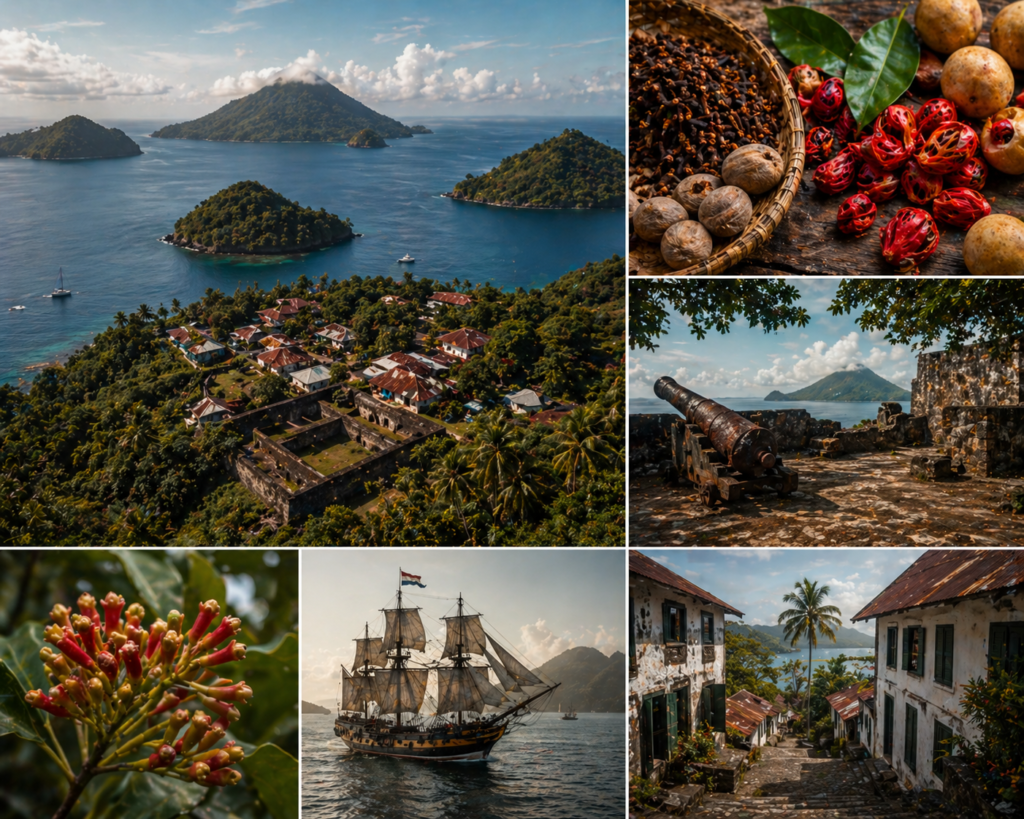
The geography of the Bandas is dominated by Gunung Api, a near-perfect volcanic cone that rises sharply from the deep indigo waters. Beneath its shadow, the islands of Banda Neira and Banda Besar function as a natural botanical citadel. The volcanic soil, combined with the humid, salt-laden air, created the perfect micro-climate for nutmeg and cloves. Unlike modern plantations, the nutmeg forests of Banda are majestic, cathedral-like groves where the spice trees grow under the shade of towering Kenari (almond) trees. Walking through these forests is like entering a living museum of the 16th century.
Stone Sentinels of the Monopoly
The architectural legacy of the spice trade is written in coral and basalt. Fort Belgica, a massive pentagonal fortress built by the Dutch East India Company (VOC), sits atop a hill overlooking the harbor. Its primary purpose was not to protect the islands from outside invaders, but to police the spice trees and ensure that not a single nut left the island without Dutch profit. The fort’s thick walls and watchtowers remain as silent witnesses to the “Spice Wars”—a period where a pound of nutmeg in Europe was worth more than its weight in gold, capable of financing entire navies.
The Shadow of 1621
To trace the legacy of cloves and nutmeg is to confront the dark “Shadow of 1621.” In their quest for a total monopoly, the VOC, under Jan Pieterszoon Coen, decimated the indigenous Bandanese population. Those who weren’t killed were exiled, replaced by a system of perkeniers (plantation owners) and enslaved labor. This forced migration changed the DNA of the islands forever. Today, the Bandanese culture is a unique, resilient fusion of those who survived and those who were brought there—a “Spice Creole” identity found in their music, their Belang (war boat) races, and their cuisine.
The Architecture of Decay and Resilience
In Banda Neira, the colonial “Indo-European” mansions—once home to wealthy spice merchants—exist in a state of beautiful, atmospheric decay. Overgrown with bougainvillea and stained by tropical rains, these buildings feature high ceilings and Dutch floor tiles that have cooled the feet of merchants for three hundred years. Yet, the true resilience lies in the local markets. Here, nutmeg is still dried in the sun on bamboo mats, and cloves are spread out on the pavement, turning the streets into a fragrant, reddish-brown carpet.
A Forgotten Equilibrium
Today, the Bandas have returned to a quiet, isolated equilibrium. The global demand for nutmeg no longer fuels world wars, but the spice remains the lifeblood of the islands. The legacy of the trade is found in the deep-sea trenches that surround the islands, now home to some of the world’s most pristine coral reefs, and in the spirit of the people who have reclaimed their land from the ghosts of monopoly. To visit Banda is to realize that while the “Spice Age” has passed, the islands themselves remain—a fragrant, volcanic reminder of the time when a handful of seeds dictated the fate of the world.