- Location: Pancoran-Glodok Urban Corridor, West Jakarta
When midnight settles over the historic commercial alleys of Glodok, Jakarta’s oldest Chinatown transitions from a frantic, hyper-congested trade hub into a cinematic, shadow-drenched urban canvas. This dense labyrinth of streets is a living architectural archive, where centuries-old Chinese courtyard eaves and weathered, early 20th-century Art-Deco facades stand squeezed between modern wholesale concrete blocks. These five night-photography and heritage loops invite you to grab an analog camera or a low-light prime lens, stepping into the quiet, rain-slicked alleys after the heavy steel shop shutters have closed to capture the striking visual friction between historical geometry and raw, ambient neon glows.
1. The Art-Deco Shutter Drop-Loop
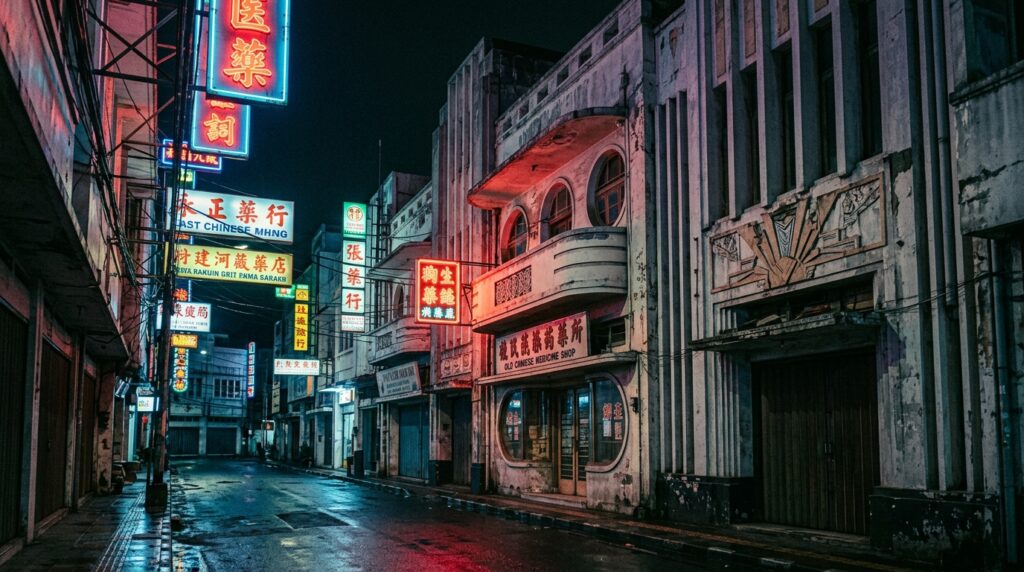
The late-night visual study begins along the main artery of Jalan Pancoran just after the final wholesale markets power down their lights. As the chaotic daytime crowds evaporate, the true structural anatomy of the street is revealed. You will focus your lens on the striking, symmetrical lines of early 1900s commercial buildings, characterized by their recessed balconies, stepped geometric ziggurats, and ornamental plaster moldings. Framed against the dark night sky and illuminated only by distant streetlamps, these faded Art-Deco facades offer a hauntingly beautiful, monochrome study of Jakarta’s early modern mercantile architecture.
2. The Neon-Reflection Wet-Alley Trail
This high-contrast loop takes you off the main boulevard and deep into the narrow, winding passageways of Gang Gloria. After a tropical evening downpour, the uneven asphalt and worn stone paving slabs turn into a highly reflective mirror. The environment is dominated by the glowing orange, crimson, and green neon characters of traditional medicine shops and multi-generational noodle stalls that stay open past midnight. Adjusting your camera aperture to capture the long, bleeding streaks of colored light stretching across the wet ground provides an intense, atmospheric masterclass in urban cinematic composition.
3. The Red-Brick Courtyard Void
Leaving the neon-lit corridors behind, you will navigate toward the quiet perimeter of a restored heritage compound hidden behind a row of modern shophouses. Stepping through a low brick archway, you enter a silent, open-air central courtyard. The architecture here combines traditional southern Chinese masonry with colonial Batavia utility—featuring heavy timber support beams and weathered red-brick pillars. Standing in the center of this absolute spatial void, looking straight up at how the dark clay roof tiles neatly slice the midnight sky, creates a powerful, grounding feeling of isolation right in the heart of the metropolis.
4. The Shadow-Grid Shophouse Walk
This loop focuses on the unique urban geometry of Glodok’s iconic Ruko (rumah toko/shophouse) streetscapes. Walking slowly along the covered pedestrian arcades—known historically as the five-foot ways—you will map the dramatic patterns created by long rows of heavy, corrugated steel rolling doors. The sharp, vertical lines of the iron shutters combined with the rhythmic casting of shadows from the overhead concrete beams create a highly minimalist, industrial pattern. Capturing the lone figure of a night watchman or a passing bicycle traversing this geometric shadow-grid brings a timeless, human narrative to your framing.
5. The Rooftop-Ledge Twilight Frame
The final photography loop takes you up the dark, concrete stairwell of an old, open-air parking structure or commercial block overlooking the Glodok intersection. Stepping onto the unguarded top deck, you are presented with a sweeping, panoramic view of the urban landscape at its quietest hour. Below you, the empty, winding asphalt lanes look like silent rivers cutting through a dense jungle of historic tile roofs and modern glass monoliths. Setting up a long-exposure shot to catch the occasional amber headlights of a late-night transport truck slicing through the historic grid brings your midnight architectural safari to a peaceful, contemplative close.