- Location: Arborek Tourism Village, Central Raja Ampat
On a tiny, sun-bleached coral island in the heart of the Dampier Strait, the traditional custodians of the sea have developed a material culture entirely shaped by the surrounding ocean and maritime forests. Arborek Island is a quiet sanctuary defined by its white sand pathways, overwater stilt architecture, and a deeply rooted weaving heritage that uses wild coastal plants to create functional art. These five cultural exploration trails guide you past the island’s vibrant jetty drop-offs and into the shaded courtyards of the village, where you will join communal weaving circles to master the ancient art of working with wild orchid fibers and walk among the weathered wooden totems that protect this remote island community.
1. The Sea-Pandanus Leaf Harvest and Preparation
This tactile heritage experience begins on the wild, northern shoreline of the island, where the salt-tolerant Pandanus bushes grow directly out of the coral sand. Guided by a village elder, you will learn the meticulous process of selecting and cutting the long, spike-edged leaves without damaging the plant. Returning to a shaded timber veranda, you will watch the traditional preservation technique: using a sharp shell to strip away the thorny edges, boiling the green ribbons over an open wood fire to soften the cells, and dragging them over a smooth wooden dowel to flatten them into strong, flexible weaving strips that dry to a beautiful golden-tan hue.
2. The Wild Orchid-Fiber Splitting Masterclass
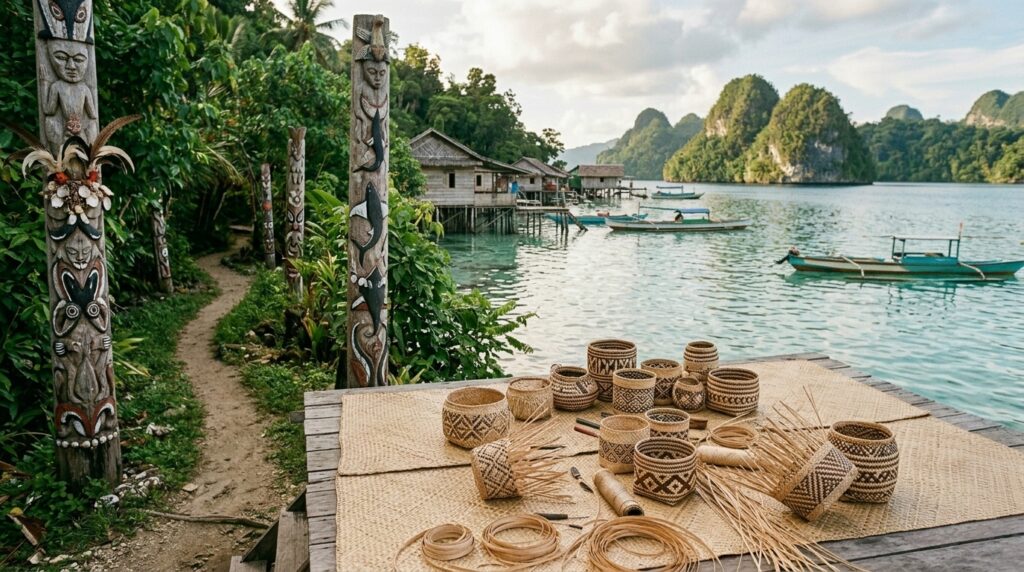
This highly focused workshop introduces you to the crown jewel of Raja Ampat’s textile arts: Serat Anggrek (wild orchid fiber). Harvested from the stalks of specific epiphytic orchids growing deep within the mainland jungle canopies, this rare material is prized for its exceptional tensile strength and natural, glossy yellow color. Sitting on a woven floor mat, a master weaver will show you how to use a small bone knife to meticulously split the dried orchid stalks into thread-like fibers. The process requires incredible patience and hand control, teaching you the exact physical precision required to prepare materials for elite tribal regalia.
3. The Noken Basket Weaving Circle
With your materials prepared, you will take your place inside an open-air communal pavilion to learn the geometric hand-movements of weaving the Noken—the iconic, multi-functional woven bag of Papua. The women of Arborek are famous for their unique, tight-knit circular weaving patterns, often shaping the baskets to resemble traditional sea turtles or manta rays. As you rhythmically loop and knot the pandanus strips and yellow orchid fibers under the guidance of the village artisans, the repetitive motion becomes deeply meditative, accompanied only by the soft murmur of the ocean waves breaking against the nearby stilt houses.
4. The Ancestral Clan Totem Trail
Moving out of the weaving circles, this historical walking trail explores the hidden spiritual geometry of the village. Following a narrow sand path flanked by wild hibiscus trees, you will locate several weathered, hand-carved ironwood totems (Mbis) anchored into the ground. These ancient sculptures feature stylized carvings of ancestral guardians, marine spirits, and sea birds, acting as historical boundary markers and spiritual protectors for the local clans. A local cultural storyteller will interpret the carved motifs for you, revealing how the island’s martial history and maritime mythologies are permanently frozen into the grain of the wood.
5. The Jetty-Line Sunset Reflection
The final heritage experience takes place at dusk on the long timber planks of the Arborek jetty, where the village meet the deep blue of the Dampier Strait. As the equatorial sun drops beneath the horizon, painting the sky in deep shades of violet and crimson, the village children gather on the beach to play traditional acoustic string-band music. Holding your handmade orchid-fiber creation in your hands, you can sit on the edge of the pier, watching giant manta rays glide silently through the clear, glowing water below, bringing your immersive journey into Raja Ampat’s living coastal culture to a peaceful close.