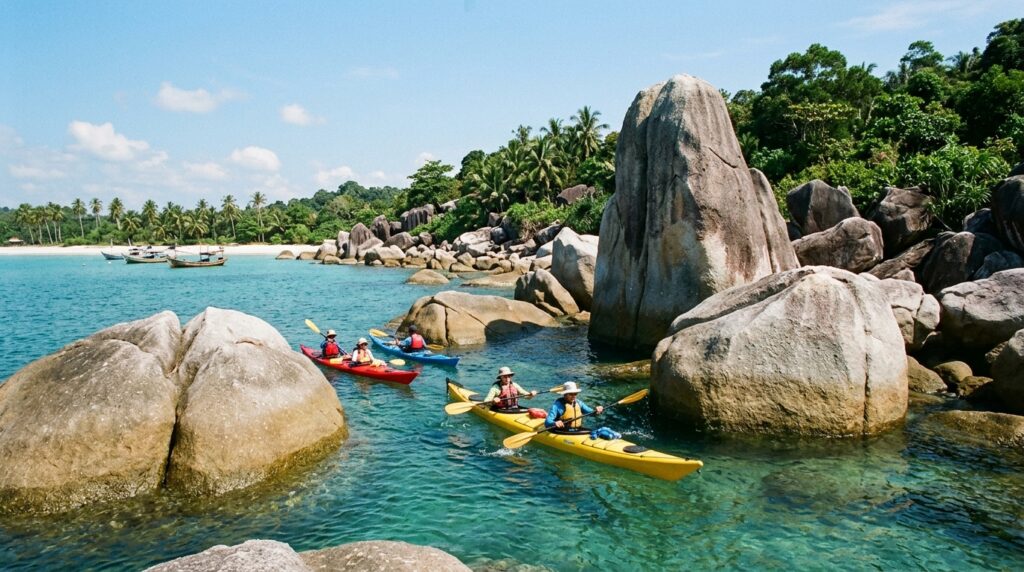
Trikora Beach, winding across the rugged eastern coast of Pulau Bintan, features a dramatic marine landscape dominated by colossal, smooth granite boulder formations. Rising sharply from the shallow turquoise water like ancient monoliths, these unique geological structures create a maze of narrow waterways, hidden chambers, and protected pockets of sand. These five sea kayaking expeditions invite you to grab a paddle and navigate this labyrinth under your own power, exploring a wild, rocky coastline that can only be fully accessed by a low-profile, non-motorized craft.
1. The Labyrinth Paddling
Launching from the soft sands of Trikora Beach KM 35, you instantly steer your sea kayak into a massive cluster of smooth, grey granite boulders that sit just fifty meters offshore. The expedition requires careful maneuvering as you paddle through narrow, tight channels where the rock faces rise three meters high on either side, completely blocking out the coastal wind. Gliding across the calm, glass-like water trapped inside these stone alleys allows you to look straight down at the white sand bottom, watching small reef crabs scuttle across the submerged base of the rocks. It is a quiet, highly technical paddle that turns the coastline into a natural stone playground.
2. The Hidden Cove Landings
This route takes you around the rocky headlands of Trikora Beach KM 38, where centuries of wave action have carved deep fractures into the massive granite walls. Navigating your kayak tight against the shoreline reveals secret, crescent-shaped pockets of white sand that are entirely hidden from the main island road by the giant stones. Timing your approach with the high tide allows you to ride a gentle swell right through a split in the rock, beaching your kayak on a pristine, isolated shore that feels completely untouched. Sitting in your own private, boulder-enclosed cove offers an unmatched sense of discovery and absolute isolation.
3. The Shipwreck Snorkeling
Paddling out from the fishing shores of Trikora Beach KM 41, this adventure leads you one kilometer into the open waters of the South China Sea toward a shallow, historic wooden fishing wreck. Reclaimed entirely by local marine life, the ribs of the sunken vessel rest in just three meters of water, surrounded by a natural barrier of submerged granite blocks. You will tie your kayak to a floating mooring line, slide over the side with a mask and snorkel, and explore the site. Drifting over the wreck reveals vibrant schools of clownfish, soft purple sea anemones, and large blue-spotted stingrays resting on the sandy floor around the hull.
4. The Rock Climbing Scrambles
Set against the dramatic, windswept rock formations of Trikora Beach KM 46, this hybrid expedition combines water endurance with a rugged land scramble. You will paddle your craft to the base of a massive, sloping granite monolith that juts far out into the deep coastal current. After safely securing your kayak in a sheltered rock eddy, you will step onto the warm, coarse stone and use natural handholds to scramble up the weathered face of the boulder. Reaching the broad, flat summit rewards you with a spectacular, 360-degree panoramic view of the vast South China Sea and the long line of coconut palms tracing the Bintan coast.
5. The Open-Ocean Crossing
Designed for experienced paddlers seeking a true physical challenge, this final expedition begins at the northern tip of Trikora Beach KM 50. Under the guidance of an expert coastal tracker, you will launch into the open swell for a two-kilometer crossing toward an isolated, rocky lighthouse islet sitting out on the horizon line. Fighting the steady lateral ocean currents requires a rhythmic, powerful paddling technique, balancing your body against the rolling waves. Reaching the remote outpost, where the historic light tower sits anchored directly into a foundation of raw granite, provides a deeply rewarding sense of achievement as you rest before the return paddle to the mainland.