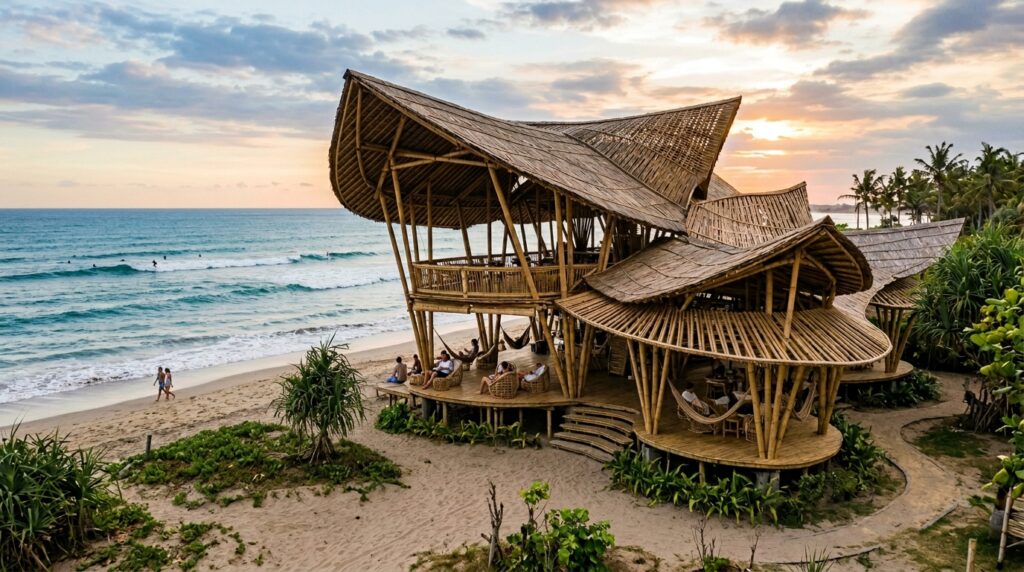
In the arid, sun-drenched hills of South Lombok, traditional air conditioning is being replaced by the genius of fluid dynamics. These five bamboo estates are “living machines,” engineered with aerodynamic roofs and porous walls that funnel the powerful trade winds of the Indian Ocean into a constant, cooling flow. Here, luxury is defined by the invisible movement of air.
1. The Vortex Wing at Selong Belanak
Perched on a ridge overlooking the crescent bay, this pavilion features a dramatic, asymmetrical roof shaped like an airplane wing. The design creates a natural pressure differential—a “venturi effect”—that pulls hot air out of the living spaces while forcing a cool, high-speed breeze through the center. Built entirely from black “Petung” bamboo, the structure vibrates slightly in high winds, a gentle reminder of the raw oceanic power being harnessed to keep the interior perfectly chilled without a single fan.
2. The Lattice Helix in Kuta Heights
This residence is a masterpiece of “breathable” architecture. Instead of solid walls, the house is encased in a double-layered bamboo lattice, inspired by traditional Sasak weaving. The gaps in the weave are mathematically calculated to break turbulent gusts into a soft, laminar flow that moves horizontally across every room. At night, the house “glows” as light spills through the lattice, while the interior remains a sanctuary of cool, filtered air and shifting geometric shadows.
3. The Sail-Cloth Sanctuary
Combining structural bamboo with high-tech marine canvas, this pavilion looks like a ship caught in mid-tack. The massive white sails are not just aesthetic; they are adjustable “wind-scoops” that can be rotated to catch the breeze regardless of the season. The main living hall is a sunken lounge, allowing the heaviest, coolest air to settle at floor level, creating a natural “refrigeration” effect that makes it the ultimate retreat during the peak of the tropical midday heat.
4. The Porous Monolith at Are Guling
Standing tall on a limestone cliff, this estate uses verticality to its advantage. The central stairwell acts as a “thermal chimney,” allowing rising heat to escape through a vented skylight while drawing in the sea spray from the base of the cliff. The bamboo pillars are bundled in a way that allows air to pass through the structure’s skeleton, ensuring that even on the hottest days, there is never a pocket of stagnant air. It is a design that doesn’t just resist the wind—it breathes with it.
5. The Bamboo Fold at Gerupuk
Inspired by the art of origami, the roof of this pavilion is a series of folded bamboo planes designed to trap the “Offshore Flow” that surfers love. The folds create natural channels that direct the wind toward the master suites, located at the narrowest points of the “funnel.” The flooring is made of split bamboo with tiny gaps between the slats, allowing the cool air trapped in the shaded space beneath the house to rise naturally, providing a constant, passive underfloor cooling system.