In the remote, sacred forests of Banten, Indonesia, the Baduy people have perfected a form of architecture that breathes. While modern engineering often relies on the extraction of resources and the pouring of concrete, the Baduy Dalam (Inner Baduy) utilize “Slow Engineering”—a method where bridges are not constructed, but guided. These living structures are a masterclass in ancient bio-engineering, proving that humanity can cross divides without scarring the earth.
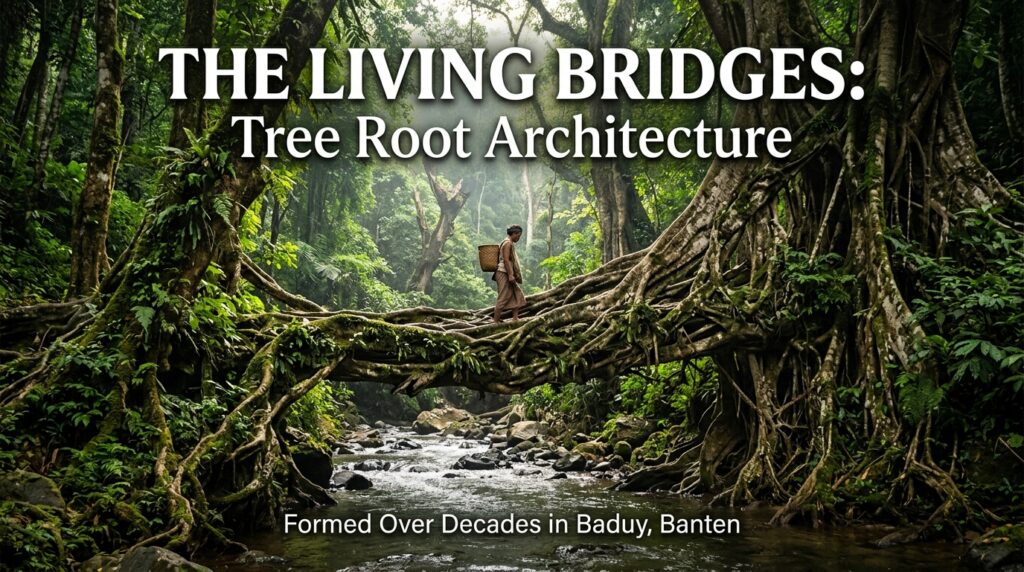
1. The Blueprint of Guided Growth The living bridges of the Baduy are formed from the aerial roots of the Ficus elastica (rubber tree). The process begins with a vision that spans generations. Because young roots are flexible but weak, the Baduy create a temporary scaffolding of bamboo to “train” the roots to grow across the river. Over decades, as the roots reach the opposite bank and plant themselves into the soil, they thicken and harden, eventually becoming a singular, load-bearing organism.
2. The Strength of Anastomosis Unlike a conventional bridge that begins to weaken the moment it is finished, a living bridge grows stronger over time. Through a biological process called anastomosis, the roots that touch each other eventually fuse together, creating a natural lattice that is incredibly resilient. If a part of the bridge is damaged, the tree’s natural healing properties repair the structural breach. It is a self-maintaining infrastructure that can last for centuries, provided the parent trees remain healthy.
3. The Philosophy of Pikukuh The existence of these bridges is rooted in the Pikukuh—the ancestral mandate of the Baduy to live in total harmony with nature. This philosophy forbids changing the course of rivers or leveling the land for construction. The living bridge is the ultimate technological solution to this spiritual constraint. It allows the community to navigate the rugged terrain of West Java without violating their vow to leave the natural world undisturbed.
4. The Emerald Twilight Walking across a living bridge is a sensory journey into the heart of the jungle. The structure is often covered in layers of slick moss, ferns, and secondary vines, making it appear as a natural extension of the forest floor. Suspended over fast-flowing rivers, these bridges exist in a state of perpetual emerald twilight, shielded by the dense canopy above. The “deck” of the bridge is a complex weave of thick, knotted “muscles” that vibrate with the rhythm of the water below.
5. Engineering Across Generations The most profound aspect of the living bridges is the timeline of their creation. A bridge started by a grandfather may only be fully safe for heavy passage by the time his grandson reaches adulthood. This requires a level of communal patience and intergenerational planning that is rare in the modern world. These bridges stand as living proof that the most sustainable technology is not always the fastest—it is the one that grows in balance with the life around it.