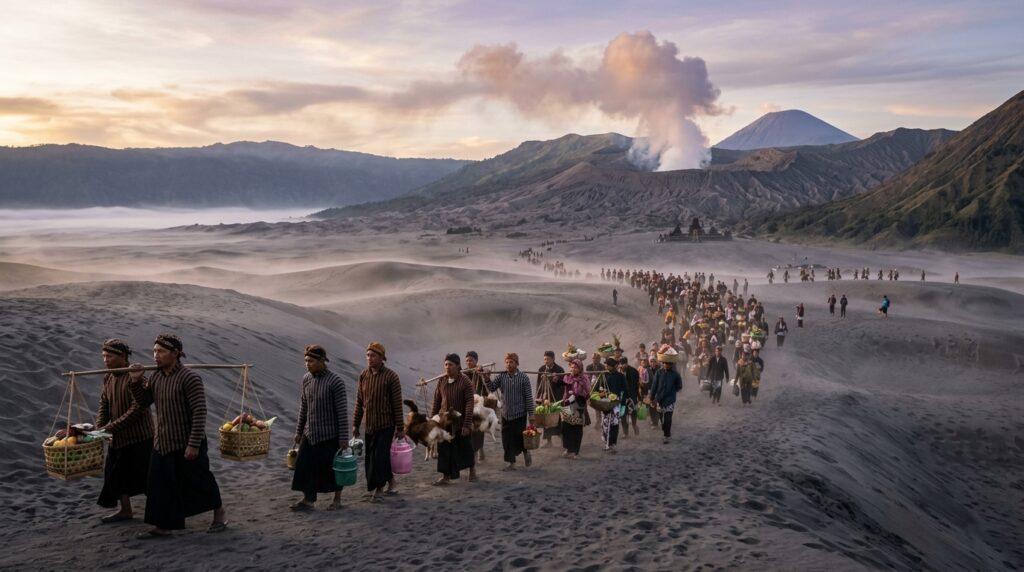
At the heart of the Tengger massif in East Java lies the Segara Wedi—a vast, desolate sea of volcanic sand that feels like the edge of the world. This monochromatic void, surrounded by towering crater walls, is the ancestral home of the Tenggerese people. It is a landscape defined by extreme minimalism, where the visual world often dissolves into a sea of grey-on-grey, shrouded in a perpetual, ghostly mist.
1. The Geometry of a Volcanic Desert The “Sea of Sand” is a massive caldera formed by ancient eruptions. The environment is dictated by wind and ash, where the volcanic grit is sculpted into rhythmic, mathematical ripples that stretch toward the horizon. In this “Acoustic Desert,” sound is swallowed by the thick fog, leaving only the whispering wind and the muffled thud of horse hooves. It is a place of profound solitude, where the vast scale of the crater makes the human presence feel small and temporary.
2. The Legend of Roro Anteng and Joko Seger The spiritual weight of Bromo is rooted in a 15th-century legend. The Tenggerese ancestors, Roro Anteng and Joko Seger, were said to be childless and prayed to the mountain gods for help. Their prayers were answered with twenty-five children, but with a divine condition: they must sacrifice their youngest child, Jaya Kusuma, back into the crater. This mythic pact formed the foundation of the Tenggerese identity and their eternal bond with the volcano.
3. The Ritual of Yadnya Kasada Every year, during the full moon of the Kasada month, thousands of Tenggerese pilgrims journey across the whispering sands to the rim of the active crater. In a profound act of gratitude and sacrifice, they throw offerings—crops, livestock, and hand-made goods—into the smoking abyss. This is not a ritual of fear, but a renewal of a sacred covenant. The sight of hundreds of flashlights and torches winding up the mountain in the pre-dawn darkness transforms the grey desert into a trail of living light.
4. The Architecture of the Void The landscape of Bromo is defined by its “high-key” monochromatic palette. During the dry season, the dust and mist create a world without high contrast, where the sky and the ground bleed into one another. The only vertical interruptions are the silhouettes of the Hindu temple, Pura Luhur Poten, which sits defiantly in the middle of the sand sea. The temple’s dark volcanic stone architecture serves as a grounding point in a landscape that otherwise feels like a floating, ethereal mirage.
5. A Dialogue with the Earth To stand on the whispering sands of Bromo is to experience the raw power of planetary forces. The constant low rumble of the crater and the shifting textures of the ash remind us that the earth is alive and ever-changing. For the Tenggerese, the sand is not dead debris, but a sacred material that holds the echoes of their ancestors. It is a place where the physical labor of the trek meets the spiritual weight of the sacrifice, creating a landscape that is as much a state of mind as it is a geological wonder.