
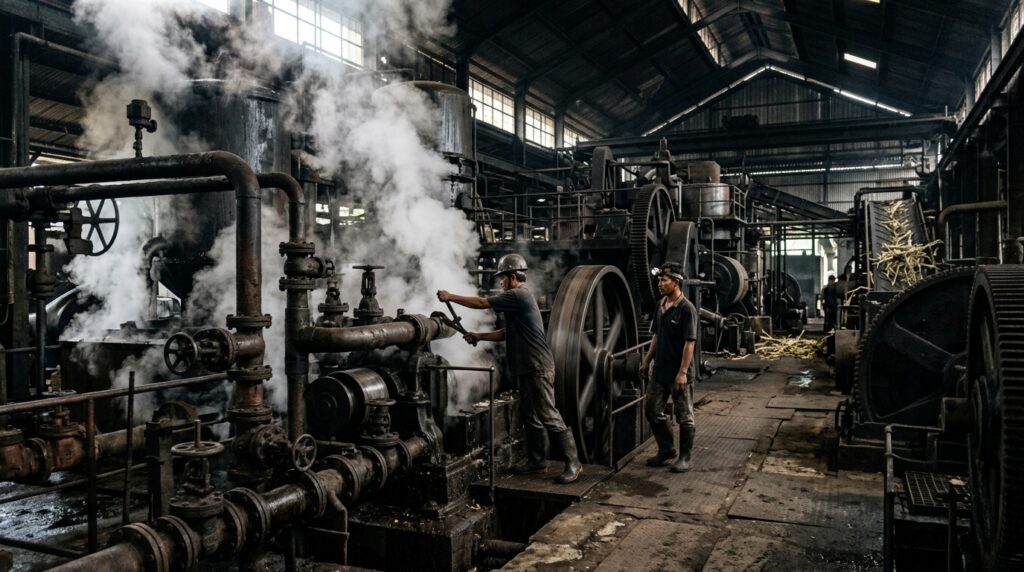
In the heart of Central Java, away from the ancient stone temples and terraced rice fields, lies a world of Screws, Steam, and Shadows. These are the colonial-era sugar mills—massive, rusted cathedrals of the Industrial Revolution that transformed Indonesia into a global powerhouse of production in the 19th century. Today, sites like De Tjolomadoe and the still-breathing mills of East and Central Java stand as monuments to a “Mechanical Melancholy,” where the sheer scale of the machinery creates a landscape of brutal, industrial art.
The Architecture of the Leviathan
To enter a Java sugar mill is to step inside the skeleton of a giant, sleeping beast. The architecture is defined by its colossal interior volumes: soaring ceilings, corrugated iron walls, and towering brick chimneys that pierce the tropical sky. Inside, the space is a dense thicket of Victorian engineering. Massive flywheels, some three meters in diameter, are connected to a labyrinth of interlocking gears and copper piping. The design was purely functional, yet the result is a masterpiece of industrial geometry—a repetitive rhythm of circles and lines that reflects a time when machines were built to last for centuries.
The Aesthetic of Rust and Oil
The color palette of these mills is a deep, saturated study in oxidized iron and grease. Decades of heat and humidity have coated the cast-iron turbines in a rich patina of amber and burnt sienna. In the active mills, the air is thick with the scent of burnt bagasse (sugar cane fiber) and hot oil, creating a visceral, sensory experience. Sunlight filters through high, dust-caked windows, creating sharp, dramatic beams that illuminate the “shadow-play” of the machinery. It is a world of high-contrast visuals, where the pitch-black corners of the factory floor meet the golden glint of polished brass gauges.
Steam: The Invisible Pulse
The soul of these mills is the steam. During the milling season, the buildings hum with a low-frequency vibration that can be felt in the soles of your feet. Steam hisses from ancient valves, shrouding the rhythmic movement of the pistons in a ghostly white mist. This is kinetic art on a grand scale. The constant, thumping heartbeat of the steam engines provides a soundtrack to the labor, a reminder of an era before the silent efficiency of microchips. Here, power is visible, loud, and physical.
The Human-Machine Symbiosis
These mills represent a unique intersection of Dutch colonial technology and Javanese labor. The machinery—often bearing the stamps of foundries from Glasgow, Amsterdam, or Berlin—was adapted to the local environment, creating a hybrid industrial culture. The “shadows” in these mills are not just physical; they are the historical shadows of the millions who labored here. The industrial art of the sugar mills is therefore a complicated beauty, representing both technical genius and the heavy weight of colonial history.
A Monument to the Mechanical Age
In an era of sleek, invisible technology, the sugar mills of Central Java offer a return to the tangible. Every bolt is visible, every gear-tooth is exposed,
and every leak tells a story. They are some of the last places on Earth where one can witness the raw, unfiltered power of the age of steam. Whether preserved as museums or continuing to grind cane as they have for over a hundred years, these mills remain Indonesia’s most imposing industrial landscapes—a place where screws, steam, and shadows converge into a powerful, rusted epic.