1. Punakha Dzong: The Palace of Great Happiness
Widely considered the most beautiful in the country, Punakha sits at the confluence of two rivers—the Pho Chhu (Male) and Mo Chhu (Female). In spring, the lilac-colored jacaranda trees bloom against the stark white walls, creating a reflection in the water that looks like a floating mirage. It is the winter residence of the central monastic body and a masterpiece of Bhutanese woodcraft.
2. Tiger’s Nest (Paro Taktsang): The Gravity-Defying Icon
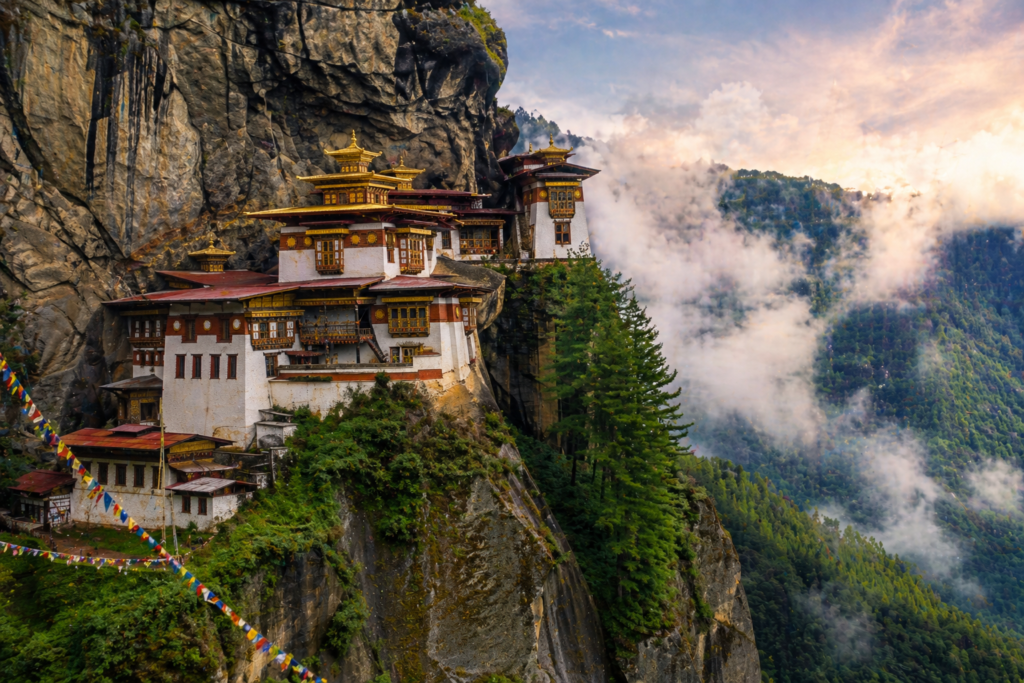
While technically a monastery, Taktsang functions with the defensive isolation of a fortress. It clings to a sheer granite cliff 900 meters above the Paro Valley. Legend says Guru Rinpoche flew here on the back of a tigress. The architecture is a triumph of human will, a series of interconnected temples that seem to grow directly out of the mountain’s vertical cracks.
3. Trongsa Dzong: The Vanguard of the East
This is Bhutan’s most strategically impressive fortress. Built on a narrow spur overlooking the Mangde Chhu gorge, it commanded the only path between the east and west of the country for centuries. Its multi-level rooftops and courtyards drop away into the mist, creating a massive, sprawling labyrinth that feels like a city unto itself.
4. Rinpung Dzong: The Fortress on a Heap of Jewels
Dominating the Paro Valley, this Dzong is famous for its towering exterior walls and its massive wooden drawbridge, the Nyamai Zam. Its interior is a treasure trove of sacred murals and intricate carvings. During the Paro Tshechu festival, the courtyard becomes a stage for masked dances that have remained unchanged for hundreds of years.
5. Tashichho Dzong: The Fortress of the Glorious Religion
Located in the capital, Thimphu, this Dzong serves as the seat of the government and the King’s throne room. It is a grand, formal structure characterized by its golden triple-tiered roofs and manicured gardens. Unlike the rugged mountain fortresses, Tashichho exudes a sense of royal serenity and administrative power.
6. Wangdue Phodrang Dzong: The Ridge-Top Guardian
Perched on a ridge overlooking the junction of two rivers, this Dzong was recently rebuilt after a devastating fire. The reconstruction is a testament to the survival of ancient Bhutanese craftsmanship. Its position is purely tactical, designed to catch the fierce winds of the valley, which the locals believe carry the prayers of the monastery to the heavens.
7. Jakar Dzong: The Castle of the White Bird
Located in the sacred Bumthang Valley, Jakar is perched on a hill overlooking the town. It is unique for its water tower—a protected passage that allowed the fortress to access water during a siege. The name “White Bird” comes from the legend that a roosting bird signaled the auspicious location for the fortress to be built.
8. Lhuentse Dzong: The Isolated Citadel
Tucked away in the remote northeast, Lhuentse is built on a rocky outcrop that looks like the prow of a ship. It is the ancestral home of the Royal Family. Because of its isolation, it feels like a relic of a forgotten age, surrounded by steep cliffs and the silence of the Kuri Chhu valley.
9. Simtokha Dzong: The First of the Great Fortresses
Built in 1629, this is the oldest Dzong in Bhutan that remains intact. It is smaller and more compact than the others, serving as a prototype for the grander structures that followed. It is famous for its 300 slate carvings of Buddhist saints and deities, many of which date back to its original construction.
10. Gasa Tashi Tongmon Dzong: The Fortress of the Northern Frontier
Set against the backdrop of the snow-capped Himalayas, Gasa is the northernmost fortress, originally built to protect against invasions from the north. It has a unique circular shape compared to the rectangular designs of other Dzongs. In the winter, the white walls and the snow-covered peaks blend into a single, monochromatic landscape of stone and ice.