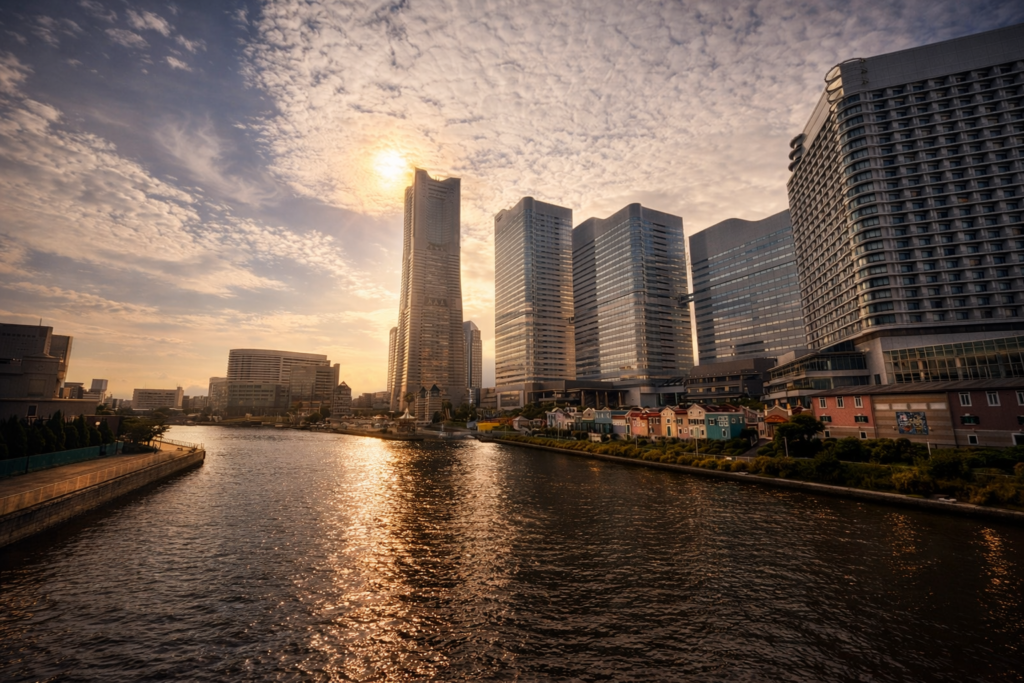
The first light of morning drapes gently across Yokohama’s riverside, touching glass facades and polished water with a grace that feels almost ceremonial. Here, where modern architecture meets a quiet sweep of the bay, the city awakens not with noise but with reflection—of light, of purpose, of design. "Morning Grace Along Yokohama’s Riverside Skyline" is a moment suspended between movement and stillness, an urban poem of brightness and composure.
Morning Light Over Yokohama’s Reflective Skyline
At the break of dawn, Yokohama’s skyline emerges as a grand composition of mirrored silhouettes. The harbor’s smooth waters create a natural canvas, bending and doubling towers in delicate shimmer. Each glint on the rippled surface tells of careful proportion—the Minato Mirai district rising in glass and steel, yet softened by the golden hue of morning’s first touch. This daily scene feels contemplative, as though the city pauses to acknowledge its own beauty before the rhythm of the day begins.
The juxtaposition of modern architecture and elemental nature defines Yokohama’s waterside charm. Reflections cascade down the façades, blending sky and structure, capturing both precision and impermanence. The Ferris wheel, still in its early silence, casts a circular echo upon the bay’s surface, a fleeting lens of light that completes the skyline’s artistry. Nothing feels hurried here; even the geometry of the city appears to breathe.
Along the promenades, early risers—runners, photographers, solitary walkers—inhabit the same tranquil world, each framed by the gentle brilliance of dawn. Bridges gleam faintly in tonal gradients of silver and peach. There is a rare serenity in the way Yokohama greets the sun, one that hints at an underlying discipline in its architecture and an almost meditative respect for light itself.
Architectural Calm and the Poetry of Urban Stillness
The structures that line Yokohama’s riverside carry an elegance born not merely from design but from restraint. Every line and curve seems balanced to harmonize with the surrounding elements—the openness of the bay, the horizon’s clean sweep, the measured cadence of reflections. This architectural calm speaks to Japan’s quiet mastery of proportion: beauty not in extravagance, but in clarity of intention.
Stillness becomes the city’s subtle language. In the interludes between movement—the silence before ferries depart, the soft echo of a bicycle passing along the quay—there is a poetry that defines Yokohama’s morning. The skyline, while composed of modern forms, feels timeless in this light. Its verticals become strokes in a watercolor, softened by mist, brightened by new sun. The city is both subject and observer, watching itself reflected back in the slow-moving river.
To witness morning grace here is to understand how architecture can elevate mood, how design can frame emotion. Yokohama’s riverfront reveals itself not through spectacle but through poise. Every reflection, every measured shadow, feels like a quiet vow—to remain graceful even as the day quickens, to honor the balance between human creation and nature’s light.
As the riverside begins to stir, the reflections dissipate, leaving behind only memory—the hush before the city fully wakes. Yokohama’s skyline, now bright in full sun, carries forward the dignity of those early hours. Morning grace is fleeting, but its essence endures: an elegant reminder that serenity can be found not apart from urban life, but within its reflective heart.